
Weekly Racial Justice Briefing — May 25–31, 2026
Vernellia R. Randall, Racism.org
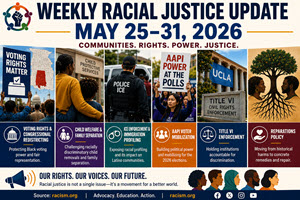 The week of May 25 through May 31, 2026, showed how racial justice fights are moving through courts, immigration enforcement, child welfare, education, voting rights, and reparations. The major pattern is clear: civil rights protections remain under direct attack, while communities of color continue to organize through litigation, public hearings, voter mobilization, and local resistance.
Table of Contents
- Federal Court Blocks Alabama Congressional Map
- New York City Sued Over Racially Discriminatory Child Removals
- ICE Street Arrests Raise Racial Profiling Concerns
- Stop AAPI Hate Launches Voter-Mobilization Arm
- Justice Department Sues UCLA Under Title VI
- New York Reparations Commission Holds Public Hearing
- Bottom Line
1. Federal Court Blocks Alabama Congressional Map
A federal three-judge court blocked Alabama from using a Republican-drawn congressional map for the 2026 elections, finding that the plan intentionally discriminated against Black voters. The blocked map would have eliminated one of Alabama’s two significantly Black congressional districts. Alabama officials then asked the U.S. Supreme Court to allow the challenged map to be used.
This is one of the most important voting-rights developments of the week because it shows that Black voting power in Alabama remains under active attack.
Why it matters:
This case shows that even after the Supreme Court weakened race-conscious redistricting protections, intentional racial discrimination remains legally vulnerable. The ruling also confirms that Black voting power is still being contested district by district, election by election.
Sources:
American Civil Liberties Union, “Voting Rights Groups Successfully Block Discriminatory Alabama Congressional Map” (May 26, 2026), https://www.aclu.org/press-releases/voting-rights-groups-successfully-block-discriminatory-alabama-congressional-map. Date Last Visited: June 2, 2026.
The Guardian, “Federal Court Blocks New Republican-Friendly Voting Map in Alabama” (May 26, 2026), https://www.theguardian.com/us-news/2026/may/26/alabama-new-congressional-map-struck-down. Date Last Visited: June 2, 2026.
NAACP Legal Defense Fund, “Voting Rights Groups Successfully Block Discriminatory Alabama Congressional Map” (May 2026), https://www.naacpldf.org/press-release/voting-rights-groups-successfully-block-discriminatory-alabama-congressional-map/. Date Last Visited: June 2, 2026.
Reuters, “Alabama Asks U.S. Supreme Court to Allow Pro-Republican Congressional Map” (May 27, 2026), https://www.reuters.com/world/alabama-asks-us-supreme-court-allow-pro-republican-congressional-map-2026-05-27/. Date Last Visited: June 2, 2026.
Reuters, “Court Blocks Alabama From Erasing Significantly Black U.S. House District” (May 26, 2026), https://www.reuters.com/world/us-court-blocks-alabama-eliminating-majority-black-us-house-district-2026-05-26/. Date Last Visited: June 2, 2026.
2. New York City Sued Over Racially Discriminatory Child Removals
Two families filed a class-action lawsuit against New York City alleging that the Administration for Children’s Services uses emergency removal powers in a racially discriminatory and unconstitutional manner. The lawsuit challenges removals of children without prior court orders and alleges that Black and Latino families are disproportionately affected.
Reporting cited data showing that roughly 90% of emergency removals affected Black and Latino families, while white families accounted for only a small percentage of such removals.
Why it matters:
Child welfare is often treated as a family-services issue, but this lawsuit frames it as a racial justice and constitutional rights issue. Emergency removal without court review can operate as family separation, especially when the state uses poverty, housing instability, or requests for help as grounds for intervention.
Sources:
Adria R. Walker, The Guardian, “New York City Sued Over Alleged Racial Discrimination in Removal of Children by Protective Services” (May 29, 2026), https://www.theguardian.com/us-news/2026/may/29/new-york-city-racial-discrimination-child-protective-services-lawsuit. Date Last Visited: June 2, 2026.
Center for Constitutional Rights, “Parents and Children in NYC File Class Action Lawsuit Claiming ACS Unconstitutionally Separates Families” (May 2026), https://ccrjustice.org/home/press-center/press-releases/parents-and-children-nyc-file-class-action-lawsuit-claiming-acs. Date Last Visited: June 2, 2026.
The Imprint, “Lawsuit Challenges New York City’s Frequent ‘Emergency Removals’ of Black and Latino Kids from Home” (May 2026), https://imprintnews.org/top-stories/lawsuit-challenges-new-york-citys-frequent-emergency-removals-of-black-and-latino-kids-from-home/274995. Date Last Visited: June 2, 2026.
The Legal Aid Society, “LAS Suit: ACS Unconstitutionally Separates Families” (May 2026), https://legalaidnyc.org/news/lawsuit-acs-unconstitutionally-separates-families/. Date Last Visited: June 2, 2026.
3. ICE Street Arrests Raise Racial Profiling Concerns
An investigation by The City reviewed more than 1,200 lawsuits and identified 430 ICE street arrests in the New York area. More than 93% of the people arrested in those street encounters were from Latin American countries, even though Latinos make up a smaller share of the undocumented immigrant population in the region.
The reporting points to a racialized pattern in immigration enforcement, with street arrests concentrated in ways that disproportionately affect Latino communities.
Why it matters:
Immigration enforcement is not race-neutral in practice. When agents concentrate enforcement in Latino neighborhoods, worksites, sidewalks, and transit areas, immigration policing becomes a racialized dragnet. This also affects U.S. citizens, lawful residents, mixed-status families, and communities already subject to over-policing.
Sources:
NAACP Legal Defense Fund, “ICE Made 400,000 Arrests in 14 Months; Black, Latinx and Immigrant Neighborhoods Bore the Brunt” (May 2026), https://www.naacpldf.org/press-release/ice-made-400000-arrests-in-14-months-black-latinx-and-immigrant-neighborhoods-bore-the-brunt/. Date Last Visited: June 2, 2026.
The City, “We Found 430 ICE Street Arrests in the New York Area. More Than 90% Were Latino” (May 2026), https://projects.thecity.nyc/ice-street-arrests-investigation-racial-profiling/. Date Last Visited: June 2, 2026.
UCLA Center for Neighborhood Knowledge, “Latino ICE Arrests, Detentions, and Removals Updates” (May 2026), https://knowledge.luskin.ucla.edu/wp-content/uploads/2026/05/UCLA_CNK_Unseen_Latino_ICE_Updates_5.26.2026.pdf. Date Last Visited: June 2, 2026.
4. Stop AAPI Hate Launches Voter-Mobilization Arm
Stop AAPI Hate launched Stop AAPI Hate Action, a nonprofit focused on registering and mobilizing Asian American and Pacific Islander voters ahead of the 2026 midterm elections. The organization’s work responds to anti-Asian racism, attacks on immigrant communities, voting-rights rollbacks, and efforts to weaken multiracial political representation.
Why it matters:
AAPI communities are often discussed only in relation to hate crimes or “model minority” stereotypes. This development shifts the frame from victimization to political power. It also recognizes that attacks on voting rights, immigrant rights, and civil rights affect Asian American and Pacific Islander communities as part of a broader multiracial struggle.
Sources:
Associated Press, “Stop AAPI Hate Launches a Nonprofit to Mobilize Voters Before Midterms” (May 2026), https://apnews.com/article/3d6ed97aa14ff2cc70ef6b59e19a4c6b. Date Last Visited: June 2, 2026.
Stop AAPI Hate Action, Home Page and Organizational Statement on Building Political Power, https://stopaapihate.org/. Date Last Visited: June 2, 2026.
5. Justice Department Sues UCLA Under Title VI
The U.S. Department of Justice sued the University of California, alleging that UCLA violated Title VI by tolerating a hostile educational environment for Jewish and Israeli students. DOJ alleged that UCLA failed to respond adequately to antisemitism connected to campus protests and related events.
UCLA denied that it had been passive and stated that it had taken steps to address antisemitism, improve safety, and respond to campus bias.
Why it matters:
This case is important because Title VI is being used aggressively in higher education, while federal civil rights enforcement has simultaneously moved away from disparate-impact protections in other contexts. The issue is not whether antisemitism should be addressed; it should.
The racial justice concern is whether civil rights enforcement is being applied consistently across antisemitism, anti-Arab racism, anti-Palestinian discrimination, anti-Black racism, anti-Asian hate, anti-Latino discrimination, and attacks on Indigenous rights.
Sources:
Reuters, “U.S. Justice Department Sues UCLA Alleging Antisemitic Educational Environment” (May 26, 2026), https://www.reuters.com/world/us-justice-department-sues-ucla-alleging-antisemitic-educational-environment-2026-05-26/. Date Last Visited: June 2, 2026.
UCLA, “Initiative to Combat Antisemitism Action Group Report” (May 14, 2026), https://chancellor.ucla.edu/wp-content/uploads/2026/05/Initiative-to-Combat-Antisemitism-Roadmap-Final-1.pdf. Date Last Visited: June 2, 2026.
U.S. Department of Justice, “Justice Department Sues University of California for Antisemitic Hostile Educational Environment” (May 26, 2026), https://www.justice.gov/opa/pr/justice-department-sues-university-california-antisemitic-hostile-educational-environment. Date Last Visited: June 2, 2026.
6. New York Reparations Commission Holds Public Hearing
New York’s Community Commission on Reparations Remedies continued public hearings on remedies for the legacy of slavery and subsequent discrimination against people of African descent. At a May 30 hearing, some participants called for direct cash reparations, including demands for large individual payments, while also emphasizing broader structural remedies in housing, education, policing, and economic opportunity.
The state commission was created after Governor Kathy Hochul signed legislation in December 2023.
Why it matters:
Reparations debates are moving from abstract moral claims to concrete policy design. The central questions are eligibility, amount, legal theory, funding, and whether remedies should be direct payments, institutional repair, or both.
For Descendants of Africans Enslaved in the United States, reparations remain a justice claim rooted in slavery, racial terror, Jim Crow, exclusion from wealth-building programs, and ongoing structural discrimination.
Sources:
New York State, “New York State Community Commission on Reparations Remedies,” https://www.ny.gov/programs/new-york-state-community-commission-reparations-remedies. Date Last Visited: June 2, 2026.
New York Post, “Some New Yorkers Demand $800K Each in Reparations as State Commission Holds Hearing” (May 30, 2026), https://nypost.com/2026/05/30/us-news/some-new-yorkers-demand-800k-each-in-reparations-as-state-commission-holds-hearing/. Date Last Visited: June 2, 2026.
Washington Times, “N.Y. Reparations Commission Holds Final Public Hearing as Residents Call for Cash Payments” (May 30, 2026), https://www.washingtontimes.com/news/2026/may/30/ny-reparations-commission-holds-final-public-hearing-residents-call/. Date Last Visited: June 2, 2026.
Bottom Line
The week of May 25–31, 2026, showed the same pattern across multiple systems: racial justice protections are being contested in courts, agencies, universities, immigration enforcement, child welfare, and state policy.
Alabama’s redistricting fight shows that Black voting power remains under attack. New York’s child welfare lawsuit shows how family separation operates through racially unequal state power. ICE arrest data shows how immigration enforcement becomes racial profiling in practice. Stop AAPI Hate’s new political arm shows communities building electoral power in response. The UCLA lawsuit shows the growing importance — and uneven use — of Title VI enforcement. New York’s reparations hearings show that repair is no longer only a historical demand; it is a live policy fight.
The bottom line is simple: civil rights are not self-enforcing. They survive only when communities document harm, challenge discrimination, build power, and insist that government institutions be held accountable.
```
Vernellia R. Randall, Professor Emerita of Law, University of Dayton School of Law. This article was drafted with the assistance of ChatGPT, an AI language model.