
Abstract
Excerpted From: M. Alejandra Torres, The Unmaking of "Conflict:" A CRT-TWAIL Analysis of the Cases of Colombia and Palestine(-Israel), 49 New York University Review of Law and Social Change 1 (2025) (394 Footnotes) (Full Document).
 Black scholars such as Derrick Bell and Kimberlé Crenshaw are credited with creating Critical Race Theory ("CRT") in the United States in the late twentieth century. CRT is an intellectual approach for unpacking systemic and legalized race relations in the United States, often but not necessarily Black-white relations. Scholars use CRT to critically analyze how the intersection of race, law, and society functions in racially stratified ways. The political project of the United States of America operates as an exceptionally racialized society, with its history of racial terror and subordination--mainly inflicted on Black people-- through state-sanctioned private behavior or legitimized and codified public action. Thus, CRT is a necessary modality through which to challenge American exceptionalism,8 hold the United States accountable for its revisionist history of race domestically and imperialism globally, and prompt it to reckon with its truth.
CRT, as a field of inquiry that appreciates lived realities and confronts power dynamics, can prove valuable beyond U.S. borders. That is, the approach of CRT and its tenets can serve a twofold purpose: (1) to assist marginalized groups in other nation-states that also operate under constructed racial hierarchies and use the law, typically constitutional law, to perpetuate a racialized exclusionary status quo; and (2) to challenge the limitations of and reconstruct international law when it has supported--either directly or indirectly--the oppressor(s) of marginalized groups.
Third World Approaches to International Law ("TWAIL"), which is a movement of international law and policy practitioners concerned with issues broadly related to the Global Majority,12 does some of this work by "support [ing] the decolonisation of the lived realities of the peoples of the Global [Majority]." The TWAIL network examines how European expansion and exploitation--past and present--of non-Europeans have enshrined an imperial international law. It has produced continuous debates about power, colonial history, difference, identity, as well as their meanings in international law.
The approach of TWAIL can serve a twofold purpose: (1) "to unpack and deconstruct colonial legacies of international law" and (2) "to decolonize the material realities of the peoples of the [Global Majority] by, in part, constructing new and alternative legal futures." While TWAIL scholars all start from the premise that international law has an imperial nature, ""problems of racialization" might be less of a "central part" of their studies; so, while race as a construct can be linked to legalized empire, this link is not always explicitly laid out in TWAIL scholarship. Thus, by CRT interrogating the legal meaning of race, CRT complements TWAIL analysis' of how colonialization--often racially charged--laid the groundwork for international law.
The contemporary world is highly interconnected because of globalization, technological advancements, and colonial legacies and imperial debris. Hence, this article joins CRT with TWAIL to explore how the global racial order makes "conflicts"--that are connected--by deconstructing said order into its elements of power, law, race, and empire,20 such that the unmaking of "conflicts" can contribute to liberation work. Examination of Colombia and Palestine, both of which are under "conflict" and are subject to "peace accords," in this way can be transformative and valuable to other marginalized groups whose struggles are reduced to ahistorical conflicts.
Part II will put CRT methods in conversation with TWAIL methods, showing how racial realism and counternarrative are key strategies for identity reclamation and visibility to resist inaccurate historical accounts and obscured racialized realities. Part III will foreground two case studies of "conflict," presenting the instrumentality of an applied joint CRT-TWAIL analysis in the process. Part IV provides a case study of Afro-Colombians, Indigenous Colombians, and the ""armed conflict" in Colombia, showing the limitations of transitional justice to narratively contend with the "conflict" as an extension of colonial racism. Part V lays out a case study of Palestine under Israel's Zionist, racialized, and militarized order, displaying the manipulation of occupation law to obfuscate Palestinian existence and self-determination through "conflict." The article demonstrates that a joint CRT-TWAIL lens can uncover the realities of ""conflict" that are legalized, colonized, and racialized (at various levels) and, in so doing, create networks of solidarity between similarly positioned groups around the world to decolonize the law.
[ . . . ]
This article analyzes the case studies of Afro- and Indigenous Colombians challenging the narrative of the "armed land conflict" and mestizaje, and of Indigenous Palestinians challenging the racial narrative of Zionism and "yet another isolated Middle Eastern conflict" through a practical combined CRT-TWAIL framework. The aims here are twofold: of theory and of praxis. Theoretically, the article challenges the implication of the global racial order in the making of conflicts, sustained by race and empire. It is forward-looking so that people, whether self-defined as CRT or TWAIL activist-scholars and those without an academic orientation, take on the marriage of CRT-TWAIL as theoretical support for their liberation work. Such a strategy, grounded in race-based counternarratives that dispel the global grip of white supremacy on sociolegal structures, can also create global networks of solidarity between racialized groups who are fighting similar battles.
Inasmuch as "conflict" is a euphemism for colonial racial structures like occupation, "racial unrest" is a euphemism for the racialized colonial subjugation of Black people in the United States. In Freedom is a Constant Struggle, political activist, philosopher, and academic Angela Davis invites readers to think about the creation of global networks of solidarity. Black and Native people in the United States are also "systematically choked by an enduring white supremacy that thrives on oppression and settler colonialism, and is backed by drones, the dispossession of territory and identity," mass incarceration, and resource grabs. Colonial oppressive white supremacy has "choked" various peoples across continents who can see themselves reflected in each other. CRT-TWAIL helps bring to light the importance of this form of intersectionality and transnational solidarity, where "national security" supports the militarized training and violence of the U.S. police that can be linked to the actions of the Israeli and Colombian police and military. Illustratively, the violent, disproportionate, and ""authoritarian" response of the NYPD--which has traveled to Israel to train383--to pro-Palestine college student encampments in spring 2024, is ""reminiscent" of police repression of 2020 George Floyd protesters. As there is racist police violence against Black men and protesters in the United States, the Palestinians also experience the same under the Israeli military.
The United States currently has the highest incarceration rate in the world, and Black people make up a disproportionate percentage of the country's incarcerated population. But during the First Intifada from 1987 to 1993, when Palestinians launched a mass resistance protest against the occupation, Palestine-Israel had the world's highest per capita incarceration rate. As for Colombia, political elites and the international system criticized the first version of the Peace Agreement as being too lenient on perpetrators. Incarceration rates illustrate how the law and global white supremacy operate in tandem to "define the permissible by establishing what is punishable," including protests against these racial-legal regimes. Instead of isolating their battles, Black and Native people in what is now the United States, Afro- and Indigenous people in what is now Colombia, and Indigenous Palestinians in their land can cultivate "political alliances" and ""transnational solidarities" against the iterations of race and empire in their own contexts, towards a more liberated global context. The work has begun. For example, Palestinian activists shared crucial advice to Ferguson protesters on how to deal with the U.S.-stamped tear gas with which they had also dealt. But there is much more work to do.
Applying a CRT-TWAIL reframing to the struggles and structural connections of other marginalized groups can contribute to this project. To begin, the struggles of Afro- and Indigenous Colombian and Indigenous Palestinian communities might resonate with Black and Native communities in the present-day United States as they demand reparations392--an element of transitional justice--for the legacy of colonization, slavery, stolen land, and "colorblind" institutions like mass incarceration. Reparations can "remedy the consequences of collective violence" from the global racial order. Tendayi Achiume's scholarship contains a CRT-TWAIL analytic lens in that she argues that "the pursuit and achievement of reparations for slavery and colonialism require a genuine 'decolonization' of the doctrines of international law that remain [legal] barriers to reparations," and as such, function as "neocolonial law." In recognizing the need to form solidarities, the racialized communities discussed herein can strive towards collectively decolonizing their situations.
A joint CRT-TWAIL analysis that deconstructs the workings of race and empire through legal settings like "conflict" can thus be a powerful tool for marginalized groups whose histories and identities have been erased or whose suffering has been normalized through the law.
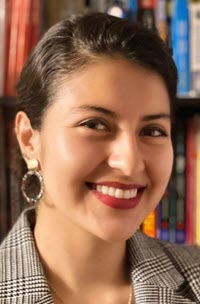
Alejandra (she/ella) graduated cum laude from NYU School of Law in 2022, where she was the Derrick Bell Scholar for Public Interest. She has worked at or interned for the Bernstein Institute for Human Rights, the Global Justice Clinic at the Center for Human Rights and Global Justice, Professor Vasuki Nesiah at NYU’s Gallatin School for Individualized Study, the International Law Commission, the ACLU Voting Rights Project, and the U.S. District Court for the Southern District of New York. In 2018, she graduated summa cum laude from NYU Gallatin with the self-titled concentration, “Empire and Postcolonial Subjectivity.” Alejandra also obtained a post-graduate