
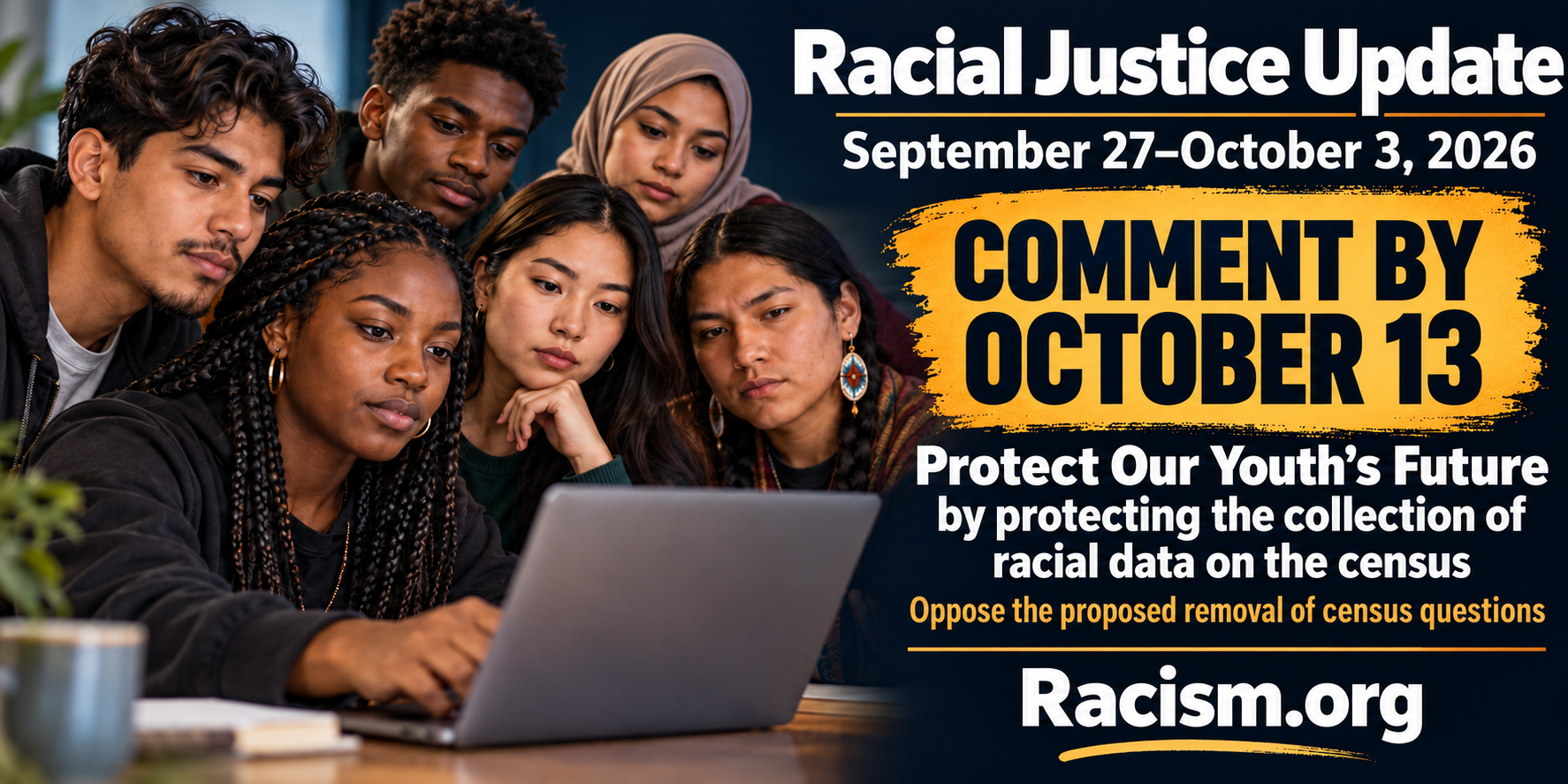
Vernellia R. Randall, Weekly Racial Justice Update: September 27–October 3, 2026, Racism.org (October 4, 2026).
Racial injustice operates through decisions about whose experiences are counted, whose rights are enforced, whose communities receive resources, and whose suffering requires an explanation. This week’s developments reach across those systems: census proposals, civil-rights enforcement, voting, employment, health care, housing, immigration, education, religious freedom, and tribal sovereignty.
The record includes both attacks on protections and efforts to build accountability. Federal agencies narrowed enforcement and redirected resources. Communities challenged discrimination, demanded answers about detention, and fought to preserve their political voice. California adopted corporate slavery-disclosure requirements and a future tax on private detention operators. Native communities advanced housing and cultural initiatives while defending their right to shape decisions affecting their lands.
These developments show why racial justice requires sustained attention to government action—and to the communities organizing against exclusion. Accountability depends on identifying what changed, who bears the consequences, and what must happen next.
Table of Contents
- Census Comments Due October 13
- Voting Rights, Intimidation, and Black Women’s Political Voice
- Black Unemployment Rises
- Proposed Jobs Program Targets Long-Term Unemployment
- D.C. Cuts Paid Family and Medical Leave
- SBA Narrows Civil-Rights Enforcement
- Minority-Health Funding Diverted to Security
- Washington Immigrants Face Medicaid Exclusions
- Direct Cash Support and Black Maternal Health
- Court Temporarily Preserves Housing-Counseling Funds
- California Requires Corporate Slavery Disclosures
- Farmers of Color Demand a Functioning USDA Advisory Committee
- Supreme Court Permits Third-Country Deportations During Review
- Wisconsin Mosque President Faces Deportation
- Death in ICE Custody Requires Answers
- Federal Incentives and Limits on ICE Vehicle Enforcement
- California Adopts a Private-Detention Tax
- Advocates Challenge Asylum Referrals Without Interviews
- Houston Police–ICE Cooperation Comes Under Scrutiny
- DOJ Issues Discrimination Finding Against UCLA Law
- Campus Racism and Institutional Accountability
- Florida Muslim Organizations Challenge Terrorism Designation
- Mosque Zoning and Discrimination Behind Neutral Rules
- Muslim Woman’s Prison Religious-Rights Lawsuit Advances
- Juvenile-Detention Agreement Requires Disability Reforms
- Remembering Indigenous Boarding-School Harm
- Red Cliff Questions Apostle Islands Redesignation
- Native-Led Housing Project Advances in Chicago
- Native Hawaiian Community Sponsorship Applications Open
- International Discussion Examines Racism and Drug Policy
- Overall Bottom Line
- Search Note
1. Census Comments Due October 13
The Census Bureau’s proposed rule would prohibit questions about race, ethnicity, and sexual orientation on the decennial census short form and other enumeration questionnaires covered by the proposal. It expressly excludes the American Community Survey and administrative data from that prohibition.
Public comments are due October 13, 2026. Racism.org published a sample comment September 30 that readers can personalize with their experiences and concerns. Anonymous comments are permitted by entering “N/A” in required identifying fields. Readers do not need to include their telephone numbers in the comment text.
Why It Matters: Removing census race questions would weaken the data used to identify racial disparities and enforce civil rights. Communities of color would lose a direct nationwide record of their populations.
Bottom Line: Submit a comment by October 13 demanding the racial data needed to document exclusion and hold government accountable.
Sources:
- Census Bureau, “Decennial Census of the Population of Americans; Proposed Residence Criteria and Proposed Regulations for Demographic Questions”, September 10, 2026. Last visited October 5, 2026.
- Racism.org, “October 13 Deadline: Comment on the Proposed Census Race and Ethnicity Rule—Sample Comment Included”, September 30, 2026. Last visited October 5, 2026.
- Regulations.gov, Comment Submission: Docket USBC-2026-0628, comment-submission page. Last checked October 5, 2026.
2. Voting Rights, Intimidation, and Black Women’s Political Voice
October 2 reporting documented concerns that immigration enforcement could intimidate voters. DHS said it had no plans for operations targeting polling places, while leaving open responses to threats. The reporting does not establish that ICE deployment at polling places is planned.
A civil-rights poll released September 30 found widespread concern about rights being rolled back and election officials facing pressure. Separate reporting September 29 highlighted a survey of 700 Black women registered voters: 92 percent were dissatisfied with the country’s direction, 95 percent expressed concern about changes to voting-rights protections, and 77 percent were very motivated to vote in the midterms.
Why It Matters: Immigration-enforcement fears can discourage participation in Latino, Asian, and immigrant communities. Black women’s responses show that threats to voting protections are also driving political urgency.
Bottom Line: Protect voters from intimidation and preserve the voting protections communities of color need to exercise political power.
Sources:
- Associated Press, Report on Immigration Enforcement and Polling-Place Concerns, October 2, 2026. Last checked October 5, 2026.
- Capital B, “92% of Black Women Voters Are Dissatisfied With America’s Direction”, September 29, 2026. Last visited October 5, 2026.
- The Highland Project, 2026 Annual National Poll, September 2026. Last checked October 5, 2026.
- The Leadership Conference on Civil and Human Rights, “New Civil Rights Monitor Poll”, September 30, 2026. Last visited October 5, 2026.
3. Black Unemployment Rises
Employment figures released October 2 showed Black unemployment rising from 6.0 percent in August to 7.0 percent in September. September unemployment was 3.6 percent for white workers, 2.9 percent for Asian workers, and 4.7 percent for Hispanic workers. The overall rate was 4.2 percent, and payroll employment increased by 29,000.
The figures document a substantial racial gap. They do not, by themselves, establish the cause of the monthly increase.
Why It Matters: Black unemployment was nearly twice white unemployment. That unequal access to work threatens Black families’ income, housing stability, and ability to build wealth.
Bottom Line: Economic progress must be measured by whether the Black–white employment gap closes, not merely whether total employment grows.
Source:
- Bureau of Labor Statistics, “The Employment Situation—September 2026”, October 2, 2026. Last visited October 5, 2026.
4. Proposed Jobs Program Targets Long-Term Unemployment
Senator Chris Van Hollen introduced the Ready to Work Act September 30. The proposal would support employment, training, and related services for people unemployed for at least six months. It includes support for communities experiencing persistent poverty and joblessness and for worker-owned enterprises.
The legislation is a proposal, not an operating benefit program.
Why It Matters: The proposed program could address prolonged joblessness in communities facing racial employment barriers. Its reach will depend on who obtains the jobs and support.
Bottom Line: Evaluate implementation by access for Black workers and other excluded communities, job quality, and reductions in persistent unemployment.
Sources:
- Senator Chris Van Hollen, “As AI Threatens American Workforce, Van Hollen Introduces Legislation to Create Jobs and Tackle Long-Term Unemployment”, September 30, 2026. Last visited October 5, 2026.
- The Washington Informer, “Sen. Van Hollen Introduces Plan to Fund Temporary Jobs”, September 30, 2026. Last visited October 5, 2026.
5. D.C. Cuts Paid Family and Medical Leave
Changes taking effect October 1 reduced D.C.’s paid family-caregiving leave from 12 weeks to six and medical leave from 12 weeks to ten. The maximum weekly benefit fell from $1,190 to $1,100. Parental leave remained at 12 weeks, and prenatal leave remained at two.
Why It Matters: Cutting paid leave makes caregiving depend more heavily on family savings. The racial-justice question is whether workers of color can afford the income loss or must return before care needs end.
Bottom Line: Assess who loses benefits by race and income—and whether the cuts force workers to choose between earnings and family care.
Source:
- The Washington Informer, “D.C. Workers Lose Half of Their Paid Family Leave”, October 1, 2026. Last visited October 5, 2026.
6. SBA Narrows Civil-Rights Enforcement
A Small Business Administration rule took effect September 29 removing affirmative-action provisions and ending the agency’s pursuit of Title VI disparate-impact liability against federal funding recipients. Intentional discrimination remains prohibited. Racial disparities may still serve as evidence of intentional discrimination.
Why It Matters: Ending disparate-impact enforcement removes a way to challenge policies that exclude people of color without proving discriminatory intent.
Bottom Line: The rollback narrows federal accountability for racial barriers in SBA-funded programs, even when those barriers produce unequal access.
Source:
- Small Business Administration, “Removing Constitutional Concerns From SBA Programs”, September 29, 2026. Last visited October 5, 2026.
7. Minority-Health Funding Diverted to Security
September 29 reporting highlighted an earlier transfer of $12 million from the Office of Minority Health to help cover Health Secretary Robert F. Kennedy Jr.’s security costs. It also described the cancellation of 16 university and nonprofit grants in August.
These were earlier actions receiving renewed scrutiny during the update week, rather than funding decisions newly made September 29.
Why It Matters: Diverting minority-health funds removes resources specifically intended to address racial health disparities. The loss falls on work serving communities already facing unequal health outcomes.
Bottom Line: Require an accounting of which racial-health programs lost support, whom they served, and how the funding will be restored.
Source:
- Word In Black, “HHS Cuts Minority Health Budget for RFK Jr.’s Security”, September 29, 2026. Last visited October 5, 2026.
8. Washington Immigrants Face Medicaid Exclusions
New federal eligibility restrictions took effect October 1, affecting categories of immigrants previously eligible for Washington’s Apple Health coverage. Asian American and Native Hawaiian/Pacific Islander community leaders raised concerns about the consequences.
A September 30 court order protected coverage for more than 800 Washington residents receiving Supplemental Security Income. COFA migrants remain among qualifying groups. The exclusions therefore should not be described as applying uniformly to every immigrant community.
Why It Matters: These exclusions threaten coverage within Asian, Pacific Islander, and other immigrant communities. Eligibility distinctions can divide families’ access to care even when their medical needs are the same.
Bottom Line: Document coverage losses by affected community and immigration category, while preserving court-protected coverage and identifying remaining options.
Sources:
- AsAmNews, “Health Coverage in Danger for 11,000 Washington State Immigrants”, October 2, 2026. Last visited October 5, 2026.
- Washington State Health Care Authority, “Court Order Protects Apple Health Coverage for More Than 800 Washingtonians”, October 1, 2026. Last checked October 5, 2026.
- Washington State Health Care Authority, Noncitizen Apple Health Coverage Guidance, undated guidance. Last checked October 5, 2026.
9. Direct Cash Support and Black Maternal Health
October 1 reporting examined local guaranteed-income efforts supporting pregnant people and new mothers. An Atlanta pilot provides 25 participants with $1,000 monthly during pregnancy and the first year after birth.
The small program offers direct support; its existence alone does not establish improved maternal-health outcomes.
Why It Matters: Cash support addresses financial pressures that medical treatment alone cannot resolve. For Black maternal health, the question is whether support improves access to care and safer pregnancy and recovery.
Bottom Line: Evaluate benefits for Black mothers directly; a small cash pilot cannot substitute for adequate health coverage and accountable maternity care.
Source:
- Word In Black, “Cash for Moms: As Medicaid Cuts Loom, Cities Test a New Approach to Black Maternal Health”, October 1, 2026. Last visited October 5, 2026.
10. Court Temporarily Preserves Housing-Counseling Funds
A federal judge temporarily blocked a deadline threatening nearly $56 million in housing-counseling funds while a challenge to the administration’s actions proceeds. The dispute includes allegations that funding decisions retaliated against organizations associated with diversity, equity, and inclusion.
Separately, New York’s attorney general announced a September 30 lawsuit challenging housing-counseling funding cuts. The temporary order is not a final ruling on the merits.
Why It Matters: Cutting counseling can weaken assistance used to challenge barriers to homeownership and housing stability. Targeting organizations for equity work threatens the infrastructure addressing racial exclusion.
Bottom Line: Preserve counseling access and examine whether funding cuts disproportionately remove assistance from communities facing racial housing barriers.
Sources:
- New York Attorney General, “Attorney General James Sues Trump Administration to Protect Housing Counseling for New Yorkers”, September 30, 2026. Last visited October 5, 2026.
- Reuters, “US Judge Blocks Housing Grant Cuts While Anti-DEI Challenge Proceeds”, October 1, 2026. Last checked October 5, 2026.
11. California Requires Corporate Slavery Disclosures
California signed AB 2599 September 30. Covered businesses with annual worldwide gross receipts exceeding $100 million must investigate and disclose specified records of involvement in slavery. Coverage includes businesses whose predecessors existed by December 31, 1964.
The law provides for a public digital platform. Disclosure deadlines depend on later implementation; the law does not order immediate reparations payments.
Why It Matters: Disclosure can connect present corporate wealth to profits from enslavement and give Black descendants evidence needed to pursue accountability.
Bottom Line: Require complete, accessible records so corporate involvement in slavery can be investigated rather than hidden by mergers and name changes.
Sources:
- California Legislature, “AB 2599: Slavery—Corporate Disclosures”, official bill text and legislative record. Last visited October 5, 2026.
- Council on American-Islamic Relations, “CAIR-CA Welcomes Governor Newsom’s Signing of Bill Requiring Corporations to Disclose Ties to Slavery”, October 1, 2026. Last visited October 5, 2026.
12. Farmers of Color Demand a Functioning USDA Advisory Committee
September 30 reporting documented the continuing freeze of USDA’s Advisory Committee on Minority Farmers. Former members said its work was paused in February 2025. The agency’s annual report recorded no meetings or recommendations in 2025.
Farmers are seeking congressional intervention. In a September 28 response, USDA declined to discuss the committee or announce appointments.
Why It Matters: Freezing the committee removes a formal channel through which Black, Asian, and other farmers of color can challenge barriers in USDA programs.
Bottom Line: Restore a functioning advisory body and require USDA to answer farmers’ concerns about unequal access to federal support.
Source:
- Capital B, “A Key Voice for Farmers of Color at USDA Has Gone Silent Under Trump”, September 30, 2026. Last visited October 5, 2026.
13. Supreme Court Permits Third-Country Deportations During Review
On September 29, the Supreme Court stayed a lower-court ruling restricting third-country deportations, allowing the administration to resume them while review continues. The dispute concerns safeguards for people sent to countries other than their own, including notice and opportunities to raise fears of torture.
The stay is not a final judgment approving the policy.
Why It Matters: Third-country removal places migrants’ safety in government hands while limiting their ability to contest dangerous destinations. Examine whose nationalities and communities bear these risks.
Bottom Line: Require notice and a meaningful opportunity to raise danger claims before removal, with transparent reporting on who is affected.
Source:
- Reuters, “Supreme Court Lets Trump Resume Third-Country Deportations”, September 29, 2026. Last checked October 5, 2026.
14. Wisconsin Mosque President Faces Deportation
An immigration judge ruled September 30 that Salah Sarsour, president of Wisconsin’s largest mosque, could be removed on foreign-policy grounds. The judge rejected a separate misrepresentation claim. Sarsour intended to appeal.
He had been released from detention in June after a federal judge found substantial grounds for his claim that the administration was targeting him for his advocacy.
Why It Matters: Deportation proceedings against a Palestinian Muslim community leader raise concerns that immigration powers are being used to punish advocacy and chill his community’s speech.
Bottom Line: Scrutinize the foreign-policy rationale and protect Palestinian and Muslim advocates’ ability to speak without retaliatory immigration enforcement.
Source:
- Associated Press, “US Can Deport the Leader of Wisconsin’s Largest Mosque on National Security Grounds, Judge Rules”, published by WTTW, September 30, 2026. Last visited October 5, 2026.
15. Death in ICE Custody Requires Answers
Julian Curo-Churata, a 47-year-old Peruvian national, died September 29 at Ochsner LSU Health–Monroe Medical Center in Louisiana while in ICE custody. October 1 reporting described an agency notice that did not explain the cause of death or the events leading to hospitalization.
Why It Matters: A Peruvian migrant died while the government controlled his access to care. Accountability requires examining his treatment, including language access and any nationality-based barriers.
Bottom Line: Release the medical and custody findings needed to determine what happened and whether preventable failures contributed to his death.
Source:
- Latin Times, “A Peruvian Man Died in ICE Custody in Louisiana—Three Days On, No One Has Said Why”, October 1, 2026. Last visited October 5, 2026.
16. Federal Incentives and Limits on ICE Vehicle Enforcement
October 2 reporting showed that Miami-Dade’s sheriff’s office became eligible for approximately $14.6 million under a federal immigration-enforcement program after seven immigration arrests during April–June. Eligibility does not establish payment, and the figures do not establish a fixed payment rate for each arrest.
Separately, a September 30 ICE memo reported October 1 prohibited vehicle pursuits and PIT maneuvers when drivers fail to pull over. ICE characterized the memo as a reminder rather than a policy change. Vehicle stops remain permitted.
Why It Matters: Financial rewards for immigration partnerships can intensify policing in Latino and other immigrant communities. Vehicle pursuits add physical danger to those encounters.
Bottom Line: Disclose funding, stops, arrests, and pursuit violations so communities can identify unequal targeting and demand accountability.
Sources:
- ABC News, “ICE Memo Lays Out Limits on Vehicle Stops”, October 1, 2026. Last visited October 5, 2026.
- Latin Times, “Miami-Dade’s Seven Immigration Arrests Made Sheriff’s Office Eligible for $14.6 Million: Report”, October 2, 2026. Last visited October 5, 2026.
17. California Adopts a Private-Detention Tax
California signed AB 1633 September 29. Beginning July 1, 2028, private detention operators face an annual tax equal to 25 percent of their defined California gross income. Proceeds are directed toward immigration legal services through the Due Process for All Fund, subject to appropriation.
Why It Matters: The tax could redirect detention revenue toward representation for immigrants facing removal, including communities of color navigating a system with substantial language and financial barriers.
Bottom Line: Ensure revenue reaches accessible legal services and measure whether detained people obtain meaningful representation.
Sources:
- California Immigrant Policy Center, “Governor Newsom Signs First-in-the-Nation Tax on Private Immigration Detention Corporations”, September 29, 2026. Last visited October 5, 2026.
- California Legislature, “AB 1633: Taxation—Private Detention Facilities”, official bill text and legislative record. Last visited October 5, 2026.
18. Advocates Challenge Asylum Referrals Without Interviews
Comments submitted September 28 and published September 30 opposed an interim rule allowing asylum referrals to immigration court without an asylum interview. Advocates raised concerns about lost opportunities to present claims, immigration-court backlogs, and the rulemaking process.
The comments challenge the rule; they are not a court decision invalidating it.
Why It Matters: Removing interviews can reduce opportunities for asylum seekers to explain persecution and overcome language barriers before referral to court. Effects should be examined across nationalities and racial groups.
Bottom Line: Preserve a meaningful opportunity to present protection claims and track whether procedural changes produce unequal access.
Source:
- Immigrant Legal Resource Center, “ILRC Comment Opposing Interim Final Rule on Asylum Referrals Without Interview”, September 30, 2026. Last visited October 5, 2026.
19. Houston Police–ICE Cooperation Comes Under Scrutiny
A legal analysis published September 30 examined Houston police involvement in immigration enforcement. It argued that the department’s practices extend beyond what Texas law requires and emphasized the distinction between administrative ICE warrants and judicial criminal warrants.
This was new analysis of existing practices, rather than an announcement of a new Houston policy.
Why It Matters: Police involvement in immigration enforcement can expose Latino and other immigrant residents to detention during ordinary encounters and discourage them from seeking protection.
Bottom Line: Require Houston to disclose whom its ICE referrals affect and justify detentions with clear legal authority.
Source:
- Immigrant Legal Resource Center, “A Snapshot of the Houston Police Department’s Policy to Call ICE on Community Members”, September 30, 2026. Last visited October 5, 2026.
20. DOJ Issues Discrimination Finding Against UCLA Law
On October 1, DOJ announced an administrative finding alleging that UCLA Law discriminated against white and Asian applicants in admissions during 2023–2025. Its announcement addressed application essays and admissions comparisons and said it would seek voluntary compliance before litigation.
The announcement is an agency finding, not a judicial judgment.
Why It Matters: The finding directly concerns alleged exclusion of Asian and white applicants. Racial-justice analysis requires examining actual admissions treatment, rather than assuming score differences alone establish discrimination.
Bottom Line: Test DOJ’s evidence and legal reasoning while protecting equal access to legal education for every racial group.
Source:
- Department of Justice, “Justice Department Finds UCLA Law School Discriminates Based on Race in Admissions”, October 1, 2026. Last visited October 5, 2026.
21. Campus Racism and Institutional Accountability
On September 28, Keegan Wilson pleaded guilty to disorderly conduct and simple assault following an August 31 incident at a gathering of Black UNC–Chapel Hill students. September 30 reporting described students’ accounts of racial slurs, thrown objects, fear, and delayed police response. He received a suspended sentence and probation.
Separately, October 1 reporting reproduced a police announcement that two Louisiana Tech students had been arrested on disturbing-the-peace charges following a racial-slur incident. Those charges are not convictions.
Why It Matters: These incidents concern Black students’ ability to gather and participate in campus life without racist abuse. University response determines whether equal access includes actual protection.
Bottom Line: Require accountability for racist conduct and campus failures in prevention, emergency response, and support for affected Black students.
Sources:
- Capital B, “Black UNC Students Say the University Failed Them After a Racist Attack”, September 30, updated October 2, 2026. Last visited October 5, 2026.
- Lincoln Parish Journal, “Two Tech Students Arrested in Connection to Racial Slur Incident”, October 1, 2026. Last visited October 5, 2026.
22. Florida Muslim Organizations Challenge Terrorism Designation
Following Florida’s September 29 terrorism designation of CAIR and CAIR-Florida, the organizations filed a new lawsuit October 1 and sought emergency relief October 2. The designation was scheduled to take effect November 5.
An earlier lawsuit was dismissed because the plaintiffs lacked standing when it was filed. That dismissal did not decide the merits of the new designation.
Why It Matters: Designating Muslim civil-rights organizations as terrorist entities can stigmatize the communities they represent and obstruct their ability to challenge discrimination.
Bottom Line: Scrutinize the designation’s evidence and legality, including its consequences for Muslim civil-rights advocacy and participation.
Source:
- American Civil Liberties Union, “Muslim Civil Rights Organizations in Florida Urge Court to Block Unconstitutional Terrorism Designation”, October 3, 2026. Last checked October 5, 2026.
23. Mosque Zoning and Discrimination Behind Neutral Rules
A Muslim community filed a federal lawsuit September 28 challenging Marlboro Township, New Jersey’s denial of its mosque proposal after a lengthy approval process. The lawsuit alleges discriminatory treatment; those allegations have not been adjudicated.
On September 29, a research announcement highlighted a study examining how parking, traffic, and discretionary zoning requirements can conceal barriers to mosque approval.
Why It Matters: Parking and traffic rules can become tools for excluding Muslim congregations while appearing neutral. Compare the burdens imposed on mosques with those imposed on other institutions.
Bottom Line: Enforce equal land-use treatment and investigate whether discretionary requirements conceal anti-Muslim discrimination.
Sources:
- Asian American Legal Defense and Education Fund, “New Jersey Muslim Community Sues Marlboro Township Over Illegal, Discriminatory Denial of Town’s First Mosque”, September 29, 2026. Last visited October 5, 2026.
- Council on American-Islamic Relations, “CAIR, CAIR-CA Welcome California Study Exposing Use of Parking Complaints to Discriminate Against New Mosques”, September 29, 2026. Last visited October 5, 2026.
24. Muslim Woman’s Prison Religious-Rights Lawsuit Advances
An October 1 announcement described a federal court decision allowing a Muslim woman’s lawsuit against the Bureau of Prisons to proceed. Her claims concern forced removal of her hijab, uncovered photographs, and their continued retention and use.
The court allowed agency claims to advance while granting individual officials qualified immunity. It did not issue a final judgment granting relief.
Why It Matters: Forced hijab removal burdens a Muslim woman’s religious practice and dignity. Continued use of uncovered photographs can prolong that burden after the original encounter.
Bottom Line: Require prison policies to respect Muslim women’s religious rights and provide effective remedies when those rights are violated.
Source:
- Council on American-Islamic Relations, “CAIR, CAIR-NY Welcome Federal Court Ruling Allowing Muslim Woman’s Lawsuit Against Federal Bureau of Prisons to Move Forward”, October 1, 2026. Last visited October 5, 2026.
25. Juvenile-Detention Agreement Requires Disability Reforms
A complaint and executed settlement filed September 29 require changes at Kings County’s juvenile detention center in California. The agreement calls for expert assistance, reduced use of force, expanded programming, a less prison-like environment, and more alternatives to detention.
Claims against the county education office remain unresolved, including allegations concerning identification of disabilities and required educational services.
Why It Matters: Disability failures can deepen harm for detained youth of color. This case establishes disability concerns, but does not provide local racial data needed to assess unequal treatment.
Bottom Line: Enforce the reforms and examine force, educational access, and diversion by race and disability.
Source:
- Disability Rights Advocates, “Kings County Probation Department Agrees to Reform Juvenile Detention Center Following Disability Rights Investigation and Lawsuit”, October 1, 2026. Last visited October 5, 2026.
26. Remembering Indigenous Boarding-School Harm
September 30 remembrance activities centered the experiences of Indigenous children, families, and communities harmed by boarding schools. Organizers announced a Minneapolis gathering with a screening, vigil, and walk. California also issued a Day of Remembrance proclamation.
Why It Matters: Boarding schools attacked Indigenous families, languages, and cultures through government-backed assimilation. Their harm concerns collective survival, not only individual mistreatment.
Bottom Line: Connect remembrance to survivor-led truth-telling, access to records, cultural restoration, and institutional responsibility.
Sources:
- California Governor, “Governor Newsom Proclaims a Day of Remembrance for Indian Boarding Schools”, September 30, 2026. Last visited October 5, 2026.
- National Native American Boarding School Healing Coalition, “National Day of Remembrance”, event page for September 30, 2026; publication date not established. Last visited October 5, 2026.
27. Red Cliff Questions Apostle Islands Redesignation
Reporting September 29–30 examined Red Cliff Band concerns about proposed national-park redesignation of the Apostle Islands. Tribal leadership raised questions about consultation, treaty interests, cultural practices, environmental protection, and tourism pressures.
The legislation was introduced earlier; this week brought new reporting on the tribe’s concerns.
Why It Matters: Redesignation affects lands, waters, treaty interests, and ceremonies central to Red Cliff’s sovereignty. Tourism goals do not erase obligations to the tribe.
Bottom Line: Require meaningful tribal involvement and protection of treaty rights, cultural practices, and resources before redesignation advances.
Source:
- ICT, “The Red Cliff Band and the Future of the Apostle Islands”, September 30, 2026, as dated in the article’s republication text. Last visited October 5, 2026.
28. Native-Led Housing Project Advances in Chicago
October 2 reporting described the planned 45-unit Jigzibik At River Edge housing development in Chicago. The Native-led project is scheduled to open in December 2026 and includes space supporting cultural and community connections.
The housing is available to eligible residents generally, with outreach to Native communities; it is not exclusively Native housing.
Why It Matters: Native-led housing connects affordability with cultural belonging and community decision-making. That matters for Native residents whose housing needs can be overlooked in general programs.
Bottom Line: Assess whether Native residents obtain stable housing and whether community leadership continues to shape the development.
Source:
- ICT, “Chicago Housing Project Aims to Fulfill 70-Year-Old Promise to Native People”, October 2, 2026. Last visited October 5, 2026.
29. Native Hawaiian Community Sponsorship Applications Open
The Office of Hawaiian Affairs opened applications October 1 for its Hoʻākoakoa sponsorship cycle covering April–June 2027 events. Applications close November 30. Eligible nonprofit community organizations in Hawaiʻi may seek support for cultural events and activities connecting communities with resources; awards generally have a $15,000 maximum.
Why It Matters: Funding helps Native Hawaiian organizations sustain cultural practices and community connections through institutions rooted in their own priorities.
Bottom Line: Support accessible applications and evaluate whether awards strengthen Native Hawaiian cultural continuity and community capacity.
Source:
- Office of Hawaiian Affairs, “Apply Now for the Hoʻākoakoa Lāhui Event Sponsorship Program!”, program page; publication date not established. Last visited October 5, 2026.
30. International Discussion Examines Racism and Drug Policy
A September 30 Geneva event brought racism and drug policy into international human-rights discussion. Event materials focused on consequences for Africans and people of African descent and the role of systemic racism in drug-policy enforcement.
The materials establish the event’s purpose, not a new binding international rule.
Why It Matters: The event centers how drug enforcement affects Africans and people of African descent. Racial justice requires examining who receives punishment, who receives treatment, and why.
Bottom Line: Demand enforcement and treatment data that expose racial disparities and guide changes reducing unequal punishment.
Sources:
- United Nations, “Racism and Drug Policy Side Event—Concept Note”, materials for the September 30, 2026 event; publication date not established. Last visited October 5, 2026.
- United Nations, “Systemic Racism and Drug Policy Enforcement”, event listing for September 30, 2026. Last visited October 5, 2026.
Overall Bottom Line
This week shows how government decisions distribute protection and harm across racial and ethnic communities. Black workers face sharply unequal unemployment. Minority-health programs lose resources. Immigrant communities confront coverage restrictions and enforcement pressures. Muslim organizations challenge government stigma, while Native communities defend sovereignty, housing, and cultural continuity.
The responses identify concrete paths toward accountability: preserve racial data, enforce civil rights, fund legal representation, disclose corporate involvement in slavery, restore community participation, and protect tribal decision-making.
A signed law needs implementation. A settlement needs enforcement. A death in custody needs an explanation. A promise of consultation needs meaningful tribal involvement.
Racial justice requires institutions to answer for whom their decisions exclude—and to change the rules and practices producing that exclusion.
Search Note
This update draws on government records, legal and civil-rights organizations, mainstream reporting, and media serving Black, Latino, Indigenous, Asian American, Native Hawaiian/Pacific Islander, Muslim, and immigrant communities. It includes developments during September 27–October 3 and substantive reporting published during that period about continuing conditions or earlier actions. Event dates and publication dates are distinguished where they differ.
Vernellia R. Randall, Professor Emerita of Law, University of Dayton School of Law. This article is the sole intellectual and scholarly work of Vernellia Randall. ChatGPT was used only as a drafting aid comparable to a research or editing assistant. All concepts, analysis, legal reasoning, interpretations, and conclusions are entirely the author’s own, and the author assumes full responsibility for the content.