
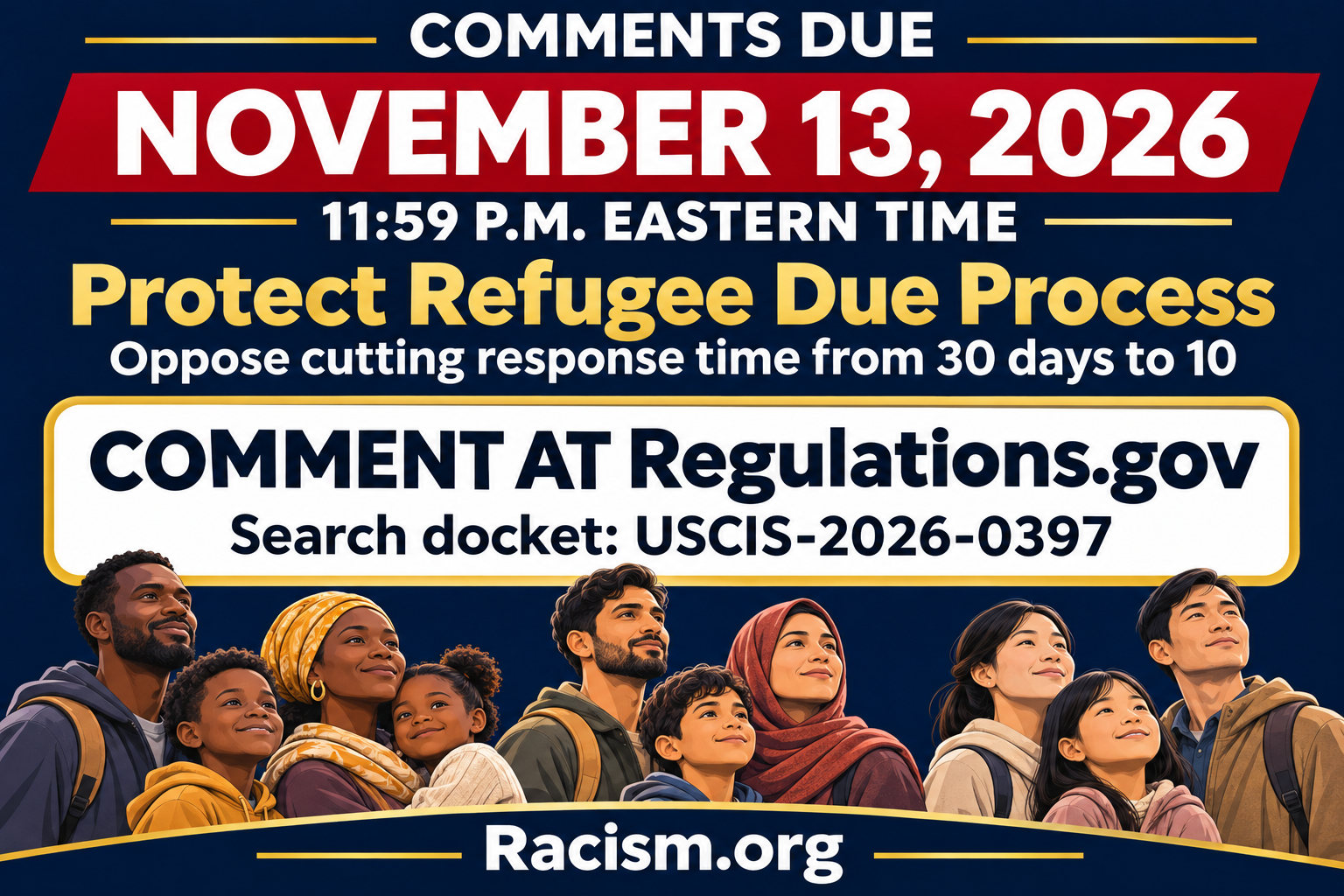
Vernellia R. Randall, “Ten Days to Defend Refugee Status: A Racial Justice Call to Action,” Racism.org (November 10, 2026).
Submit a public comment by November 13, 2026, at 11:59 p.m. Eastern Time.
Submit Your Comment on Regulations.gov
Docket No. USCIS-2026-0397
Rule: Removing 30-Day Refugee Termination Notice
The Department of Homeland Security has issued an interim final rule reducing the time refugees have to respond to a Notice of Intent to Terminate their refugee status from thirty days to ten. The change concerns people DHS determines did not qualify as refugees when they were admitted. DHS is accepting public comments on the rule through November 13, 2026.
This raises a fundamental racial justice question: what does the right to respond mean when people lack the time, language access, or legal assistance needed to exercise it? A deadline can appear equal while placing unequal burdens on the people required to meet it.
The following is my comment opposing the change. Readers can use its arguments to develop their own comments.
My Comment
I oppose reducing the time refugees have to respond to a Notice of Intent to Terminate their status from thirty days to ten. DHS should withdraw this change and restore at least thirty days, with reasonable extensions when needed.
A deadline does not become fair simply because everyone receives the same number of days. Finding an attorney, securing an interpreter, understanding the government’s allegations, and obtaining records require time and resources. Refugees facing racial discrimination, poverty, limited English proficiency, disability, or trauma may face several of these barriers at once. Shortening the deadline risks making access to protection depend on access to money, English fluency, and legal assistance.
For Black refugees and other refugees of color, these barriers raise a central racial justice concern: a procedural rule can reinforce racial inequality without mentioning race. DHS should examine whether this deadline places unequal burdens on these communities and explain how it will prevent those burdens from producing wrongful terminations.
The United States has used immigration law to enforce racial exclusion, including through the Chinese exclusion laws. That history demands scrutiny when the government weakens the procedures people need to defend their right to remain here.
DHS invokes security and program integrity, but faster decisions are not necessarily more accurate decisions. The opportunity to request an interview offers little protection if a person cannot understand the notice or obtain help before the deadline expires.
The government admitted these refugees after determining that they qualified for protection. Before reversing that determination, it must give them a meaningful opportunity to answer its allegations. Losing refugee status can threaten employment, family stability, and safety. Those consequences demand careful review.
DHS should restore the thirty-day response period, provide meaningful language and disability access, allow reasonable extensions, and ensure access to the evidence supporting termination. A right to respond means little when the government denies people the time and tools needed to exercise it.
Submit Your Own Comment
Direct comment link:
https://www.regulations.gov/commenton/USCIS-2026-0397-0001
If the direct link does not open:
Visit https://www.regulations.gov, search for USCIS-2026-0397, and open the document titled “Removing 30-Day Refugee Termination Notice.” Select the comment option.
Use the following information to confirm that you have found the correct rule:
| Item | Information |
|---|---|
| Agency | U.S. Citizenship and Immigration Services, Department of Homeland Security |
| Rule title | Removing 30-Day Refugee Termination Notice |
| Docket number | USCIS-2026-0397 |
| Regulation affected | 8 CFR § 207.9 |
| Federal Register citation | 91 FR 65077, October 14, 2026 |
| Comment deadline | November 13, 2026, before midnight Eastern Time |
These identifiers and the deadline come from the published rule, checked November 10, 2026.
- Paste or type your comment into the comment field.
- Explain why you oppose the shorter deadline. Include relevant experience or examples if you wish.
- Identify U.S. Citizenship and Immigration Services and Docket No. USCIS-2026-0397 in your comment.
- Follow the form’s instructions for identifying yourself or submitting anonymously, if that option is available.
- Complete the required verification, submit your comment, and save the confirmation.
Your submission is public. DHS states that comments may be posted with the personal information you provide. Avoid including private immigration records, home addresses, or sensitive information about yourself or another person.
Ask DHS to restore the thirty-day response period and provide the language access, disability accommodations, and reasonable extensions necessary for a meaningful response. Share the comment link with others before the deadline.
Sources
U.S. Department of Homeland Security. “Removing 30-Day Refugee Termination Notice.” Federal Register, 91 FR 65077–65091, October 14, 2026.
https://www.govinfo.gov/content/pkg/FR-2026-10-14/html/2026-20956.htm
Last visited: November 10, 2026.
U.S. Government Publishing Office. United States Code, Title 8, Chapter 7, “Exclusion of Chinese,” editorial notes documenting the exclusion laws and their repeal.
https://www.govinfo.gov/content/pkg/USCODE-2020-title8/html/USCODE-2020-title8.htm
Last visited: November 10, 2026.
Vernellia R. Randall, Professor Emerita of Law, University of Dayton School of Law. This article is the sole intellectual and scholarly work of Vernellia Randall. ChatGPT was used only as a drafting aid comparable to a research or editing assistant. All concepts, analysis, legal reasoning, interpretations, and conclusions are entirely the author’s own, and the author assumes full responsibility for the content.