
Vernellia R. Randall, Weekly Racial Justice Briefing — June 15–21, 2026 (Live web search conducted June 23, 2026.)
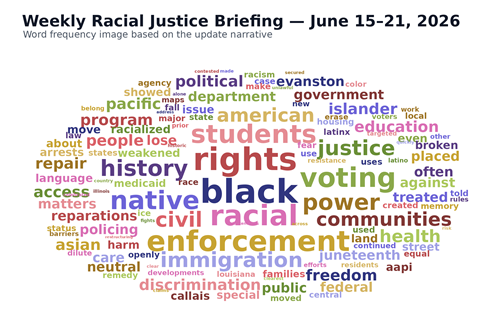
The week of June 15–21, 2026 showed how openly racial justice is being contested. Juneteenth was celebrated across the country, but the week’s major developments made clear that freedom is not secured by memory alone. The federal government moved against Evanston’s reparations program. Voting-rights fights continued after Louisiana v. Callais. Education civil rights enforcement was weakened through agency restructuring. Policing and immigration enforcement again showed how quickly Black, Native, Asian American, Pacific Islander, and Latinx communities can be placed at risk by state power.
Table of Contents
- 1. Federal Attack on Reparations
- 2. Voting Rights and Political Power
- 3. Juneteenth as a Warning, Not Just a Celebration
- 4. Education Civil Rights Enforcement
- 5. Policing, Immigration, and Racialized Enforcement
- 6. Health Equity and Public Benefits
- 7. Memory, History, and Public Truth
1. Federal Attack on Reparations
The Justice Department’s move against Evanston, Illinois’s reparations program was one of the clearest racial justice developments of the week. Evanston’s program was created to address historic housing discrimination against Black residents and their descendants. The federal government now claims the program itself is unlawful race discrimination.
That framing is dangerous. It treats a remedy for anti-Black harm as if it were the same as the original harm. It uses the language of equal protection to protect the status quo, not to repair the damage that racism created.
This case is about more than Evanston. It asks whether government can openly acknowledge specific racial harm and provide a targeted remedy. If even a carefully designed local reparations program is treated as discrimination, then the law is being used to make racial repair nearly impossible.
Sources
Reuters, “Trump Administration Challenges Reparations for Black Residents in Chicago Suburb, City Defends Program,” June 16, 2026, https://www.reuters.com/legal/government/trump-administration-challenges-reparations-black-residents-chicago-suburb-city-2026-06-16/ (Date Last Visited: June 23, 2026).
United States Department of Justice, Office of Public Affairs, “U.S. Justice Department Moves to Intervene in Race Discrimination Lawsuit Challenging Reparations Program in Evanston, Illinois,” June 16, 2026, https://www.justice.gov/opa/pr/us-justice-department-moves-intervene-race-discrimination-lawsuit-challenging-reparations (Date Last Visited: June 23, 2026).
2. Voting Rights and Political Power
Voting rights remained a central racial justice issue this week. After the Supreme Court’s decision in Louisiana v. Callais, states continued to test how far they can go in redrawing maps that weaken Black voting power.
Georgia became an important example. Republican legislative leaders declined, at least for now, to take up redistricting during a special session. That pause matters, but it is not a permanent victory. Once federal voting-rights protections are weakened, state legislatures have more room to dilute Black political power while claiming they are acting in race-neutral ways.
Native voting rights also belong in this discussion. The Native American Rights Fund warned that Callais weakens a core protection used by Native voters and other voters of color to challenge racial discrimination in voting and redistricting. Voting rights are often discussed as if they are only a Black-white issue. They are not. Native communities also face barriers tied to geography, mail access, identification rules, polling-place distance, language access, and district maps that dilute Native political power.
The issue is not abstract. Black and Native voting power affects school funding, curriculum, policing oversight, public health, environmental justice, land, water, housing, and local accountability. When communities lose representation, they lose power over the institutions that shape their daily lives.
Sources
Associated Press, “Georgia Republican Lawmakers Won’t Redraw Districts for 2028 Elections,” June 17, 2026, https://apnews.com/article/redistricting-georgia-trump-gerrymander-31f6b532e057174e68be183a9d850ec5 (Date Last Visited: June 23, 2026).
Chauncey Alcorn, “Black Voting Power Faces New Threat in Georgia Redistricting Efforts,” Capital B News — Atlanta, May 14, 2026, https://atlanta.capitalbnews.org/georgia-redistricting-black-legislators/ (Date Last Visited: June 23, 2026).
Denise Forte, “When Black Communities Lose Their Vote, Schools Pay the Price,” Word In Black, June 4, 2026, https://wordinblack.com/2026/06/when-black-communities-lose-their-vote-schools-pay-the-price/ (Date Last Visited: June 23, 2026).
League of Women Voters, “SCOTUS’s Final Blow Dismantling the Voting Rights Act,” May 21, 2026, https://www.lwv.org/blog/scotuss-final-blow-dismantling-voting-rights-act (Date Last Visited: June 23, 2026).
Native American Rights Fund, “SCOTUS Ruling Guts Voter Protections,” April 29, 2026, https://narf.org/callais-decision/ (Date Last Visited: June 23, 2026).
Supreme Court of the United States, Louisiana v. Callais, No. 24-109, April 29, 2026, https://www.supremecourt.gov/opinions/25pdf/24-109_21o3.pdf (Date Last Visited: June 23, 2026).
3. Juneteenth as a Warning, Not Just a Celebration
Juneteenth 2026 came at a moment when Black freedom, voting rights, public history, and civil rights enforcement were all under attack. The NAACP marked the holiday by calling for organizing, voting, and resistance to attacks on Black political power.
That is the right message. Juneteenth should not be reduced to a day off, a festival, or a symbol stripped of struggle. It marks delayed freedom, but it also reminds us that every Black gain has been met by efforts to limit, reverse, or contain it.
Native News Online also connected Juneteenth to the broader unfinished struggle against systemic and institutional racism. That connection matters. The history of racial subordination in the United States is not one story. It includes slavery, Indigenous dispossession, broken treaties, exclusion, segregation, forced assimilation, racialized immigration enforcement, and the ongoing use of law to deny repair.
The lesson is plain: freedom without power is fragile. Freedom without enforcement is a promise easily broken.
Sources
NAACP, “NAACP Marks Juneteenth with Call to Protect Freedom and Fight for Voting Rights,” June 18, 2026, https://naacp.org/articles/naacp-marks-juneteenth-call-protect-freedom-and-fight-voting-rights (Date Last Visited: June 23, 2026).
Native News Online, Levi Rickert, “Juneteenth Reminds America That Freedom Delayed Is Justice Denied,” June 19, 2026, https://nativenewsonline.net/opinion/juneteenth-reminds-america-that-freedom-delayed-is-justice-denied/ (Date Last Visited: June 23, 2026).
Nicky Childers, “Juneteenth: Freedom That Arrived Late and Remains Incomplete,” NewsOne, June 19, 2026, https://newsone.com/6863873/juneteenth-freedom-arrived-late-remains-incomplete/ (Date Last Visited: June 23, 2026).
4. Education Civil Rights Enforcement
The Trump administration moved to shift major Education Department functions to other federal agencies. Civil rights enforcement in education would move to the Justice Department. Special education oversight would move to Health and Human Services.
This is not just a bureaucratic shuffle. The Department of Education’s Office for Civil Rights has been a critical place for students and families challenging discrimination based on race, disability, sex, religion, and national origin. Moving that work away from an education-focused agency risks weakening expertise, slowing enforcement, and making the process harder for families to navigate.
The burden will not fall evenly. It will fall hardest on Black students, Latino students, Native students, Asian American and Pacific Islander students, disabled students, multilingual students, low-income students, and students in under-resourced districts. When civil rights enforcement is weakened, the students most dependent on enforcement are the first to pay the price.
Sources
Associated Press, “Trump Moves Special Education Out of Education Department,” June 17, 2026, https://apnews.com/article/trump-civil-rights-special-education-3483478a51ea8001fcc70e8a77d08d9a (Date Last Visited: June 23, 2026).
Denise Forte, “When Black Communities Lose Their Vote, Schools Pay the Price,” Word In Black, June 4, 2026, https://wordinblack.com/2026/06/when-black-communities-lose-their-vote-schools-pay-the-price/ (Date Last Visited: June 23, 2026).
5. Policing, Immigration, and Racialized Enforcement
The fatal police shooting of 1-year-old Kohen Wiley in Senatobia, Mississippi, again exposed the deadly consequences of racialized policing. Officers were responding to an alleged shoplifting incident involving diapers. A child is now dead. That fact cannot be treated as routine.
This kind of case forces the question we too often avoid: why do minor allegations become life-threatening encounters when Black people are involved? The value placed on property, suspicion, and control too often exceeds the value placed on Black life.
The same week, reporting on ICE street arrests in New York and New Jersey showed that Latino immigrants were overwhelmingly targeted in documented street arrests. The investigation found that 93% of the ICE street arrests reviewed involved people from Latin American countries, even though Latinos make up a smaller share of the undocumented immigrant population in that region. That is not just immigration enforcement. It is a racial profiling warning sign.
Asian American and Pacific Islander communities were also being affected by the immigration crackdown. A June 15 AP-NORC/AAPI Data poll reported that many AAPI adults said they or someone they knew had changed routines, carried proof of immigration or citizenship status, delayed travel, or experienced fear because of immigration enforcement. This matters because anti-immigrant policy does not affect only undocumented people. It creates fear among citizens, legal permanent residents, students, workers, and families who are treated as foreign no matter how long they have lived here.
That is the old “perpetual foreigner” stereotype in modern policy form. AAPI people are told they belong when their labor, money, or achievement is useful. They are treated as suspect when the government turns immigration into a racial dragnet.
Together, these stories show the same structure: Black, Brown, Asian American, and Pacific Islander communities are over-policed, over-suspected, under-protected, and then told the system is neutral. Neutral language does not erase racialized outcomes.
Sources
Associated Press, “Police Shooting of a 1-Year-Old Mississippi Boy Ignites Tension Between Police and Black Residents,” June 19, 2026, https://apnews.com/article/mississippi-child-killed-police-6765009a76070ab7e3578396dff0f6b7 (Date Last Visited: June 23, 2026).
Gwynne Hogan, Rosalind Adams, and Haidee Chu, “‘They Have All the Power’: Investigation Finds That 93% of ICE Arrests in New York and New Jersey Targeted Latinos,” The Guardian, June 20, 2026, https://www.theguardian.com/us-news/2026/jun/20/ice-investigation-new-york-new-jersey (Date Last Visited: June 23, 2026).
Northwest Asian Weekly, Terry Tang and Linley Sanders, “Most AAPI Adults Say the US Is No Longer a Great Country for Immigrants, New Poll Finds,” June 15, 2026, https://nwasianweekly.com/2026/06/most-aapi-adults-say-the-us-is-no-longer-a-great-country-for-immigrants-new-poll-finds/ (Date Last Visited: June 23, 2026).
Stop AAPI Hate, “Keeping Count | A/PI Adults Feel the Impact of ICE as Arrests Quadruple Under Trump,” March 2026, https://stopaapihate.org/2026/03/05/keeping-count-a-pi-adults-feel-the-impact-of-ice-as-arrests-quadruple-under-trump/ (Date Last Visited: June 23, 2026).
Stop AAPI Hate, “The State of Anti-AA/PI Hate in 2025,” May 1, 2026, https://stopaapihate.org/2026/05/01/state-of-hate-may26/ (Date Last Visited: June 23, 2026).
UnidosUS, “UnidosUS Condemns Congress for Handing DHS $70B with Zero Accountability Measures,” June 9, 2026, https://unidosus.org/press-releases/ (Date Last Visited: June 23, 2026).
6. Health Equity and Public Benefits
The Medicaid and CHIP Payment and Access Commission released its June 2026 report to Congress. The report addressed Medicaid community engagement requirements, prior authorization, managed care accountability, residential treatment access for youth, transitions for children and youth with special health care needs, and PACE.
These are racial justice issues. Medicaid is central to health care access for low-income communities and communities of color. Work requirements, automated systems, prior authorization barriers, and complex paperwork can deepen racial health inequities even when the rules are written in race-neutral terms.
People do not lose health care only because they are formally ineligible. They also lose it because the system becomes too hard, too punitive, or too confusing to use. That is how inequality hides inside administration.
Sources
Medicaid and CHIP Payment and Access Commission, “MACPAC Releases June 2026 Report to Congress,” June 15, 2026, https://www.macpac.gov/news/macpac-releases-june-2026-report-to-congress/ (Date Last Visited: June 23, 2026).
7. Memory, History, and Public Truth
The opening of Montgomery Square by the Equal Justice Initiative placed civil rights memory in direct tension with current efforts to erase or soften racial history. The site uses Rosa Parks’s booking number as a public symbol of resistance and criminalization.
That matters because the fight over history is never just about the past. It is about power. If the public is taught that civil rights victories were simple, inevitable, or complete, then current attacks on voting rights, Black representation, and racial repair become easier to justify.
The same is true when land acknowledgments are mocked or treated as empty political performance. Acknowledgment without repair is not enough. But mocking acknowledgment often means mocking the truth that Native land was taken, treaties were broken, and Indigenous sovereignty continues to be minimized.
Black history, Native history, Asian American history, Pacific Islander history, and Latinx history are not decoration. They are evidence. They explain why reparations are necessary, why voting rights protections matter, why policing reform is urgent, why immigration enforcement must be challenged, and why civil rights enforcement cannot be left to political convenience.
Sources
Jamil Smith, “New Monument Turns Rosa Parks’s Booking Number into Warning on U.S. Erasure,” The Guardian, June 19, 2026, https://www.theguardian.com/us-news/2026/jun/19/alabama-monument-rosa-parks (Date Last Visited: June 23, 2026).
Native News Online, Levi Rickert, “They Mocked a Land Acknowledgment. What They’re Really Mocking Is the Truth,” June 21, 2026, https://nativenewsonline.net/opinion/they-mocked-a-land-acknowledgment-what-theyre-really-mocking-is-the-truth/ (Date Last Visited: June 23, 2026).
TheGrio, “Why Vice President JD Vance’s Claim Black History Isn’t Being Erased on ‘The View’ Is False,” June 16, 2026, https://thegrio.com/2026/06/16/jd-vance-black-history-erased-the-view/ (Date Last Visited: June 23, 2026).
Vernellia R. Randall, Professor Emerita of Law, University of Dayton School of Law. This article was drafted with the assistance of ChatGPT, an AI language model.