
Vernellia R. Randall, Weekly Racial Justice Update — July 26 – August 1, 2026, Racism.org (August 4, 2026)
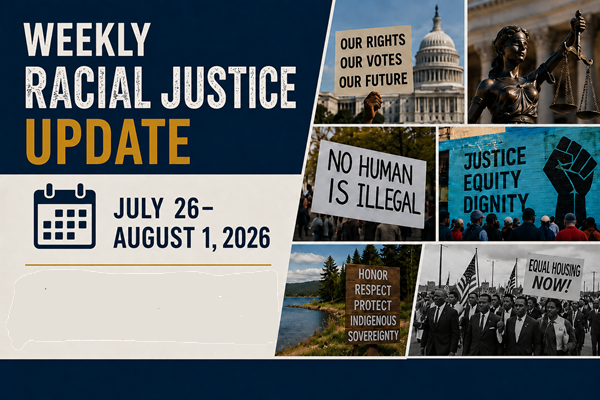
Federal civil-rights institutions moved in opposing directions during the week: some agencies and policies narrowed remedies and protections, while courts, legislatures, Tribal governments, and civil-rights organizations pressed back.
The leading developments involved the National Urban League’s 50th State of Black America report, alleged suspension of federal class-discrimination proceedings, challenges to racial profiling in immigration enforcement and Chicago traffic stops, the termination of Haitian Temporary Protected Status, voting-rights litigation, and Tribal sovereignty. Independent community-media research also identified an Arab American employment case showing how race, color, ethnicity, and religion can operate together.
Table of Contents
- National Urban League Warns That Hard-Won Black Progress Is Under Attack
- Union Sues EEOC Over Indefinite Freeze of Federal Workers’ Class Discrimination Claims
- Anti-DEI Group Expands EEOC Campaign Against Legal Fellowship for Underrepresented Students
- Government Records Reveal Alleged Racial Profiling and Racist Language in Los Angeles Immigration Stops
- Judge Certifies Class of Black and Latino Drivers Challenging Chicago Traffic Stops
- Termination of Haitian TPS Disrupts Work, Families, and Essential Services
- Two Appeals Courts Reject Expanded Mandatory Immigration Detention Without Bond
- Massachusetts Legislature Sends Broad Immigration-Protection Bill to Governor
- Mail-Ballot Executive Order Produces Separate Appeals and Continued Midterm Uncertainty
- Civil-Rights Organizations Form 2026 Midterm Election-Protection Partnership
- Voting-Rights Coalition Warns Supreme Court Has Weakened Remedies for Voters of Color
- Seventh Circuit Confirms Line 5 Pipeline Is Trespassing on Bad River Tribal Land
- Yup’ik Tribal Governments Challenge Izembek Road Permit
- Dearborn Heights Retaliation Suit Shows How Race, Color, Ethnicity, and Religion Intersect
- Thousands Retrace Martin Luther King Jr.’s Marquette Park Fair-Housing March
- Bottom Line
- Search and Source Transparency Note
1. National Urban League Warns That Hard-Won Black Progress Is Under Attack
The National Urban League released the 50th edition of its State of Black America report. The organization describes the report as an urgent warning that democracy, civil rights, and hard-won Black progress are under attack. It examines voting rights, education, employment, housing, health, criminal justice, civic participation, and the federal retreat from racial-equity work.
The report connects current conditions to the unfinished work of the Voting Rights Act of 1965. It points to restrictions on voting, attacks on diversity programs, reductions in federal civil-rights enforcement, and economic policies that place added pressure on working families. The report also highlights resistance through litigation, organizing, public policy, and community leadership.
Why It Matters
The report provides a national framework for understanding the week’s separate developments. Voting restrictions, weakened discrimination remedies, attacks on inclusion programs, and immigration enforcement are not isolated disputes. Together, they affect whether Black communities and other communities of color can use law and government institutions to protect rights already won.
The National Urban League’s conclusions are an advocacy organization’s assessment, but they are grounded in a 50-year reporting tradition and should be taken seriously as a warning about the direction of federal and state policy.
Sources
- National Urban League, “State of Black America: The 2026 Report” (2026; last visited August 4, 2026).
https://nul.org/state-of-black-america - Associated Press, “Report: American Dream Slipping Further for Black Americans” (July 30, 2026; last visited August 4, 2026).
https://apnews.com/article/40ab741f272a0e88cd00c895b0d66868
2. Union Sues EEOC Over Indefinite Freeze of Federal Workers’ Class Discrimination Claims
The American Federation of Government Employees and two federal correctional officers sued the Equal Employment Opportunity Commission. The complaint alleges that the EEOC secretly and indefinitely suspended all federal-sector class discrimination proceedings.
The two officers’ underlying case concerns alleged sexual harassment and retaliation. The larger procedural issue reaches beyond that dispute. Class proceedings allow federal workers to challenge an alleged pattern or practice affecting many employees, including systemic discrimination based on race, color, national origin, sex, age, religion, or disability. The lawsuit alleges that the freeze blocks cases from moving forward without a public rule, formal explanation, or clear end date.
The EEOC had not established unlawful discrimination merely because a class complaint was filed. The new lawsuit likewise presents allegations that must be tested in court.
Why It Matters
A right without a functioning enforcement process is difficult to use. Individual claims may not expose a workplace-wide pattern, especially where employees fear retaliation or lack the resources to litigate alone. An indefinite suspension of class proceedings can therefore weaken one of the main tools for identifying systemic discrimination inside the federal government.
The case also raises transparency concerns. An agency charged with enforcing civil-rights law should not quietly disable a major enforcement process without explaining its legal authority, scope, and duration.
Sources
- Associated Press, “A Union and 2 Prison Officers Sue the EEOC Over an Indefinite Freeze of Class Claims” (July 28, 2026; last visited August 4, 2026).
https://apnews.com/article/6761f05373f225c530d396aa6f874b97 - Reuters, “EEOC Stopped Hearing Federal Workers’ Class Action Cases, Union Claims in Lawsuit” (July 28, 2026; last visited August 4, 2026).
https://www.reuters.com/legal/government/eeoc-stopped-hearing-federal-workers-class-action-cases-union-claims-lawsuit-2026-07-28/
3. Anti-DEI Group Expands EEOC Campaign Against Legal Fellowship for Underrepresented Students
Americans for Equal Opportunity filed an EEOC complaint against Sponsors for Educational Opportunity and 14 law firms participating in a fellowship program for law students from backgrounds historically underrepresented in the legal profession.
The complaint alleges that the program discriminates against white, heterosexual, and Christian applicants. The filing is an allegation, not an EEOC finding or a court judgment. The fellowship and the law firms may dispute both the factual claims and the legal theory.
The complaint is part of a broader campaign asking federal civil-rights agencies to investigate private diversity and inclusion programs. That campaign seeks to recast programs designed to respond to longstanding exclusion as unlawful discrimination against socially dominant groups.
Why It Matters
Civil-rights statutes protect individuals of every race and religion. But equal-treatment doctrine cannot be applied responsibly without examining the history, design, and actual operation of the challenged program. A program that expands access to a profession where racial exclusion remains substantial is not automatically unlawful merely because it considers underrepresentation.
The larger issue is institutional direction. Civil-rights enforcement can be used to dismantle barriers to equal opportunity, or it can be redirected primarily toward attacking programs created to reduce those barriers.
Sources
- Reuters, “Anti-DEI Group Lodges New EEOC Complaint Against Law Firms, Education Nonprofit” (July 30, 2026; last visited August 4, 2026).
https://www.reuters.com/legal/government/anti-dei-group-lodges-new-eeoc-complaint-against-law-firms-education-nonprofit-2026-07-30/
4. Government Records Reveal Alleged Racial Profiling and Racist Language in Los Angeles Immigration Stops
Plaintiffs challenging federal immigration operations in the Los Angeles area filed a new motion for a preliminary injunction. They argue that government records produced in the litigation show officers using apparent Latino ethnicity, occupation, location, and working-class appearance as reasons to stop people.
The filing also describes text messages and body-camera evidence in which officers allegedly used racist and demeaning language about Latino people. The update does not repeat those slurs. The plaintiffs contend that the records confirm a policy or practice of suspicionless stops and unequal treatment.
The government may contest the plaintiffs’ interpretation of the evidence. The motion asks the court for interim relief; it is not a final ruling that the allegations have been proved.
Why It Matters
Immigration authority does not create a license to stop people because they look Latino, speak Spanish, perform day labor, or live in a particular neighborhood. Race and apparent ethnicity are especially unreliable markers of immigration status in a country where millions of Latino people are citizens or otherwise lawfully present.
The evidence also matters because openly racist language can reveal how institutional practices are understood and carried out by the people enforcing them. Courts should examine both formal policies and the operational culture surrounding those policies.
Sources
- ACLU of Southern California, “Government’s Own Records Reveal Racial Profiling in Federal Immigration Stops” (July 28, 2026; last visited August 4, 2026).
https://www.aclusocal.org/press-releases/governments-own-records-reveal-racial-profiling-in-federal-immigration-stops/ - U.S. District Court for the Central District of California, “Plaintiffs’ Motion for Preliminary Injunction Re: Suspicionless Stops and Violation of Equal Protection” (July 27, 2026; last visited August 4, 2026).
https://www.aclusocal.org/app/uploads/2026/07/632-2027.07.27-Plaintiffs-Motion-for-Preliminary-Injunction-re-Suspicionless-Stops.pdf - Los Angeles Times, “Immigration Agents Accused of Racial Profiling in ACLU Court Filing” (July 27, 2026; last visited August 4, 2026).
https://www.latimes.com/california/story/2026-07-27/immigration-agents-racial-profiling-aclu
5. Judge Certifies Class of Black and Latino Drivers Challenging Chicago Traffic Stops
U.S. District Judge Mary M. Rowland certified a class of Black and Latino people stopped by Chicago police since June 26, 2021, as well as Black and Latino drivers who may be stopped in the future. The lawsuit challenges what the plaintiffs describe as a citywide program of high-volume, pretextual traffic stops.
The court reviewed evidence that Black and Latino drivers were stopped and searched at disproportionate rates. The plaintiffs’ evidence also indicated that searches of Black and Latino drivers were less likely to uncover contraband than searches of white drivers. The City of Chicago denies operating an unlawful mass traffic-stop program.
Class certification permits the claims to proceed collectively. It does not decide whether Chicago ultimately violated the Constitution or the Illinois Civil Rights Act.
Why It Matters
Traffic enforcement can become a system of racial surveillance when minor violations are used as gateways to questioning, searches, and neighborhood control. The burden includes lost time, fear, humiliation, financial costs, and the risk that an ordinary stop will escalate.
Class treatment matters because the alleged injury is systemic. A citywide policy cannot be fully evaluated through isolated individual cases that treat each stop as unrelated to the others.
Sources
- U.S. District Court for the Northern District of Illinois, “Wilkins v. City of Chicago, Memorandum Opinion and Order Granting Class Certification” (July 27, 2026; last visited August 4, 2026).
https://law.justia.com/cases/federal/district-courts/illinois/ilndce/1%3A2023cv04072/434919/286/ - WTTW News, “Judge Expands Lawsuit Accusing CPD of Targeting Black, Latino Chicagoans With Traffic Stops to Include All Black, Latino Drivers” (July 30, 2026; last visited August 4, 2026).
https://news.wttw.com/2026/07/30/judge-expands-lawsuit-accusing-cpd-targeting-black-latino-chicagoans-traffic-stops
6. Termination of Haitian TPS Disrupts Work, Families, and Essential Services
The federal government treated Haiti’s Temporary Protected Status designation as terminated effective July 27 and announced that related employment-authorization documents were no longer valid. The action affected roughly 350,000 Haitian TPS holders, many of whom have lived and worked in the United States for years.
Employers began suspending workers while lawyers, labor organizations, and immigrant advocates disputed how existing injunctions affected the termination. The result was immediate confusion for workers, businesses, health-care agencies, and families. Haitian workers are heavily represented in caregiving, hospitality, food service, and other essential sectors.
TPS is temporary by statute, but ending it does not erase the reliance interests created by years of lawful residence and employment. The termination also exposes people to removal to Haiti amid severe violence, displacement, and governmental instability.
Why It Matters
Immigration status is a racial-justice issue when a policy falls heavily on a Black immigrant community and produces sudden exclusion from work, housing security, health care, and family stability. The harm also reaches U.S.-citizen children, older adults who depend on Haitian caregivers, and local economies.
The legal uncertainty is itself damaging. Workers should not lose jobs because agencies, courts, employers, and lawyers cannot agree on whether their documents remain valid.
Sources
- U.S. Citizenship and Immigration Services, “Update on Termination of Temporary Protected Status for Haiti” (July 29, 2026; last visited August 4, 2026).
https://www.uscis.gov/i-9-central/form-i-9-related-news/update-on-termination-of-temporary-protected-status-for-haiti-release-july-29-2026 - Associated Press, “Loss of Work Authorization Sows Confusion for Thousands of Haitian Immigrants and Their U.S. Employers” (July 28, 2026; last visited August 4, 2026).
https://apnews.com/article/8c35f8dd6389185e20dbed0f69fc8f65 - Associated Press, “Immigration Crackdown Threatens Haitian Caregivers and the Seniors Who Rely on Them” (July 31, 2026; last visited August 4, 2026).
https://apnews.com/article/cb291c13c9c9868ad31092183c8e039d
7. Two Appeals Courts Reject Expanded Mandatory Immigration Detention Without Bond
The U.S. Courts of Appeals for the Seventh and Ninth Circuits rejected the administration’s attempt to place many immigrants arrested inside the United States into mandatory detention without access to a bond hearing.
The courts concluded that the government was using a border-detention provision too broadly against people apprehended in the interior. Under the rulings, affected immigrants may seek an individualized bond determination under a different section of federal immigration law. Eligibility for a hearing does not guarantee release; it requires the government and an immigration judge to address the person’s circumstances.
Other federal appeals courts have accepted the government’s position, creating a circuit conflict that may ultimately require Supreme Court review.
Why It Matters
Detention can separate families, end employment, interrupt medical care, and make it much harder to obtain counsel or defend against removal. A bond hearing is a basic procedural safeguard against unnecessary confinement.
The decisions also reject the idea that everyone accused of an immigration violation may be treated as though they were newly arriving at the border, regardless of how long they have lived inside the United States.
Sources
- Associated Press, “Appeals Court Rules Against Trump on No-Bond Detention for Immigrants” (July 30, 2026; last visited August 4, 2026).
https://apnews.com/article/c32379e2730552343d4dc7690081e564 - U.S. Court of Appeals for the Ninth Circuit, “Rodriguez Vazquez v. Bostock, Opinion” (July 30, 2026; last visited August 4, 2026).
https://cdn.ca9.uscourts.gov/datastore/opinions/2026/07/30/25-6842.pdf - U.S. Court of Appeals for the Seventh Circuit, “Rojas v. Olson, Opinion” (July 30, 2026; last visited August 4, 2026).
https://media.ca7.uscourts.gov/cgi-bin/OpinionsWeb/processWebInputExternal.pl?Path=Y2026%2FD07-30%2FC%3A25-3127%3AJ%3AKolar%3Aaut%3AT%3AfnOp%3AN%3A3583247%3AS%3A0&Submit=Display
8. Massachusetts Legislature Sends Broad Immigration-Protection Bill to Governor
The Massachusetts Legislature passed the PROTECT Act and sent it to Governor Maura Healey. During the covered week, the measure was pending legislation and had not yet become law.
If signed, the bill would limit state and local participation in federal civil immigration enforcement, restrict civil immigration arrests without a judicial warrant at specified sensitive locations, bar certain immigration-status inquiries, protect advance guardianship planning, and require notice to workers when employers receive federal inspection notices. It also would create a state civil cause of action for certain constitutional violations by federal officers and restrict new 287(g) deputization agreements, subject to narrow exceptions.
The measure was developed through the Massachusetts Black and Latino Legislative Caucus and was revised through negotiations involving lawmakers, immigrant advocates, and law-enforcement representatives.
Why It Matters
States cannot cancel federal immigration law, but they can decide how their own personnel, money, buildings, and police powers will be used. The bill attempts to separate local public safety from federal civil immigration enforcement and to preserve access to schools, courts, hospitals, and disability services.
The distinction between a passed bill and an enacted law is important. Its legal effect depends on the governor’s action and any later litigation over particular provisions.
Sources
- Massachusetts Legislature, “Massachusetts Legislature Approves the PROTECT Act, Creating Among the Strongest Protections in the Nation” (July 30, 2026; last visited August 4, 2026).
https://malegislature.gov/PressRoom/Detail?pressReleaseId=1462 - Massachusetts Legislature, “Fact Sheet and Highlights: The PROTECT Act, H.5620, Final Conference Report” (July 30, 2026; last visited August 4, 2026).
https://malegislature.gov/PressRoom/Detail?pressReleaseId=1458
9. Mail-Ballot Executive Order Produces Separate Appeals and Continued Midterm Uncertainty
The administration asked the U.S. Supreme Court to stay a Massachusetts injunction blocking portions of President Trump’s executive order on federal elections. The challenged order would direct federal agencies to create citizenship-based voter lists and would alter how mailed ballots are handled.
One day later, a panel of the U.S. Court of Appeals for the District of Columbia Circuit declined to block the order in a separate lawsuit. That ruling was procedural. The panel agreed that an earlier request for an injunction had been premature before agencies issued implementing directives, while warning that a major last-minute federal overhaul of election procedures could face serious legal barriers.
The Massachusetts injunction remained the subject of the Supreme Court application. The separate cases therefore did not produce a final ruling that the executive order was lawful.
Why It Matters
The Constitution assigns election administration principally to states, subject to congressional authority over federal elections. A president has no general power to rewrite state voting systems by executive order.
Late changes are especially dangerous for voters who rely on mailed ballots, including older voters, voters with disabilities, rural voters, students, military families, and many voters of color. Uncertainty itself can discourage participation and burden election officials.
Sources
- U.S. Supreme Court, “Application for a Stay of the Injunction and Request for Administrative Stay, Trump v. California” (July 27, 2026; last visited August 4, 2026).
https://www.supremecourt.gov/DocketPDF/26/26A124/417370/20260727144320600_Trump%20v.%20California%20Application%20and%20Appendix.pdf - Associated Press, “Court Panel Declines to Block Trump’s Mail Ballot Order, but Its Status for Midterms Remains Unclear” (July 28, 2026; last visited August 4, 2026).
https://apnews.com/article/5ed040e5055c82cf84545eba36a859d8
10. Civil-Rights Organizations Form 2026 Midterm Election-Protection Partnership
The Lawyers’ Committee for Civil Rights Under Law, the National Bar Association, and the National Urban League announced a coordinated election-protection partnership for the November 2026 midterms.
The organizations plan to recruit and train volunteers for the nonpartisan 866-OUR-VOTE hotline, deploy attorneys and law students in selected jurisdictions, monitor polling places, and organize rapid responses to voting barriers. The partnership identifies Black voters and other historically marginalized communities as populations likely to face disproportionate obstacles.
Specific deployment locations will be chosen with state and local partners as the election approaches.
Why It Matters
Voting rights depend on more than statutes and lawsuits filed after an election. Real-time assistance can resolve registration errors, accessibility failures, intimidation, unlawful demands for identification, and improper denial of ballots while a voter still has an opportunity to act.
The partnership also joins national civil-rights organizations with a large network of Black lawyers and community affiliates. That combination can strengthen local knowledge, legal capacity, and public accountability.
Sources
- Lawyers’ Committee for Civil Rights Under Law, “Lawyers’ Committee, National Bar Association, and National Urban League Announce Strategic Partnership to Protect Voters During the 2026 Midterm Elections” (July 31, 2026; last visited August 4, 2026).
https://www.lawyerscommittee.org/lawyers-committee-for-civil-rights-under-law-national-bar-association-and-national-urban-league-announce-strategic-partnership-to-protect-voters-during-the-2026-midterm-elections/
11. Voting-Rights Coalition Warns Supreme Court Has Weakened Remedies for Voters of Color
Asian Americans Advancing Justice–AAJC and ten other legal advocacy organizations issued a joint assessment of the Supreme Court term. The coalition argues that the Court’s decisions and emergency-docket actions have made it harder to challenge discriminatory maps, enforce parts of the Voting Rights Act, and protect voters who need language or disability assistance.
The statement points to restrictions on Section 2 redistricting claims, questions about whether private voters and organizations may enforce federal voting protections, and the Court’s refusal to review an appellate ruling limiting private enforcement of assistance rights in several states.
This is the coalition’s legal and policy assessment, not a neutral statement issued by the Court.
Why It Matters
A legal right has limited value when the people harmed cannot bring a case to enforce it. Restrictions on private lawsuits are particularly serious when federal enforcement is weak or politically constrained.
The coalition’s membership reflects the multiracial effect of voting law. Black, Latino, Asian American, Indigenous, disabled, older, and limited-English-proficient voters may encounter different barriers, but the weakening of remedies reduces protection for all of them.
Sources
- Asian Americans Advancing Justice–AAJC, “Voting Rights Advocates Denounce Continued Supreme Court Assault on Long-Standing Voter Protections” (July 31, 2026; last visited August 4, 2026).
https://www.advancingjustice-aajc.org/press-release/voting-rights-advocates-denounce-continued-supreme-court-assault-long-standing-voter
12. Seventh Circuit Confirms Line 5 Pipeline Is Trespassing on Bad River Tribal Land
The U.S. Court of Appeals for the Seventh Circuit affirmed that Enbridge’s Line 5 oil pipeline is trespassing across land within the Bad River Band of the Lake Superior Tribe of Chippewa Indians’ reservation. Enbridge’s permission to use several parcels had expired, and the Band refused to renew it.
The decision was a mixed result. The court upheld the trespass ruling and the requirement that the pipeline ultimately be removed or rerouted from the Band’s land. It eliminated the district court’s fixed shutdown deadline, rejected the Band’s public-nuisance claim, and ordered reconsideration of the financial remedy. Enbridge therefore received additional time to complete a reroute.
The ruling does not treat the Band’s land as ordinary private property. It recognizes the Band’s sovereign authority to exclude a private company whose authorization has ended.
Why It Matters
Tribal sovereignty includes meaningful control over Tribal land. A corporation cannot continue occupying reservation property indefinitely merely because removal is expensive or inconvenient.
At the same time, the absence of a firm shutdown date may allow the trespass to continue for years. The remedy will determine whether recognition of sovereignty produces timely control of the land or only a delayed promise.
Sources
- U.S. Court of Appeals for the Seventh Circuit, “Bad River Band of the Lake Superior Tribe of Chippewa Indians v. Enbridge Energy Company, Inc.” (July 30, 2026; last visited August 4, 2026).
https://law.justia.com/cases/federal/appellate-courts/ca7/23-2309/23-2309-2026-07-30.html - ICT, “Federal Appeals Court: Oil Pipeline Trespassing on Wisconsin Tribal Land” (July 31, 2026; last visited August 4, 2026).
https://ictnews.org/news/north-central-bureau/federal-appeals-court-oil-pipeline-trespassing-on-wisconsin-tribal-land/
13. Yup’ik Tribal Governments Challenge Izembek Road Permit
ICT published detailed Indigenous-community coverage on July 28 of two lawsuits challenging a U.S. Army Corps of Engineers wetlands permit for a proposed road through the Izembek National Wildlife Refuge. The complaints themselves were filed shortly before this update’s July 26–August 1 coverage period.
One lawsuit was filed by the Native Village of Hooper Bay, the Native Village of Paimiut, the Chevak Native Village, and the Center for Biological Diversity. The plaintiffs argue that the Corps failed to lawfully examine damage to wetlands, migratory birds, subsistence hunting, and Yup’ik cultural practices.
The dispute also includes an Indigenous community supporting the road. King Cove residents and Alaska Native corporate supporters describe access to the Cold Bay airport as necessary for emergency medical evacuation, human rights, and self-determination. The case therefore presents competing environmental-justice and Indigenous interests, not a simple conflict between Native people and the government.
Why It Matters
Environmental decisions can divide Indigenous communities whose safety, culture, subsistence, land, and economic needs are not identical. Responsible racial-justice analysis should not treat Native peoples as a single voice.
The lawsuits ask whether the federal permitting process adequately considered both ecological harm and the consequences for Tribal communities that rely on the affected wildlife. The eventual remedy should address the legitimate safety needs of King Cove without treating another group’s subsistence and culture as expendable.
Sources
- ICT and Alaska Beacon, “Lawsuits Seek to Overturn Permit for Road Construction Through Alaska Wildlife Refuge” (July 28, 2026; last visited August 4, 2026).
https://ictnews.org/news/lawsuits-seek-to-overturn-permit-for-road-construction-through-alaska-wildlife-refuge/ - Center for Biological Diversity, “Lawsuit Challenges Permit to Bulldoze Road Through Alaska’s Izembek Refuge” (July 23, 2026; last visited August 4, 2026).
https://biologicaldiversity.org/w/news/press-releases/lawsuit-challenges-permit-to-bulldoze-road-through-alaskas-izembek-refuge-2026-07-23/
14. Dearborn Heights Retaliation Suit Shows How Race, Color, Ethnicity, and Religion Intersect
Former Dearborn Heights Police Chief Ahmed Haidar sued the city and Mayor Mo Baydoun, alleging wrongful termination, retaliation, breach of contract, and discrimination. The allegations have not been proved, and the defendants will have an opportunity to contest them.
The complaint describes several disputes. One has particular racial-justice significance. In October 2025, Haidar and another investigator sought to hold a news conference concerning threats allegedly made by a White man against a local mosque. According to the lawsuit, Baydoun refused because both officers were Muslim and their public appearance could be viewed negatively. The complaint alleges that the decision reflected religious bias and conveyed that Muslim officers should be kept out of public view because of their faith.
Baydoun did not respond to the newspaper’s request for comment. A city spokesperson said the court would decide the allegations.
Why It Matters
The case illustrates intersectionality. Anti-Muslim discrimination does not operate only as a private judgment about religious belief. Muslim identity may be racialized through skin color, name, ancestry, ethnicity, language, clothing, and presumed national origin. The alleged exclusion was religion-bound, but it also involved public visibility, a threatened mosque, a White alleged threat-maker, and the perceived appearance of Muslim officers.
A single-axis approach can miss this harm. Employment law may separate claims into religion, race, color, and national origin, while the lived discrimination combines them. Arab American community media is essential because it often identifies these connected harms before they receive broader attention.
Sources
- The Arab American News, “Former Dearborn Heights Police Chief Sues City and Mayor Mo Baydoun, Alleging Retaliation and Discrimination” (July 31, 2026; last visited August 4, 2026).
https://arabamericannews.com/2026/07/31/former-dearborn-heights-police-chief-sues-city-and-mayor-mo-baydoun-alleging-retaliation-and-discrimination/
15. Thousands Retrace Martin Luther King Jr.’s Marquette Park Fair-Housing March
Thousands of people retraced the 1966 Chicago Freedom Movement march into Marquette Park on August 1, marking its 60th anniversary. Dr. Martin Luther King Jr. and other marchers had faced a violent White crowd while protesting segregated housing and real-estate practices in Chicago.
The 2026 march was peaceful and included Dr. Bernice King, Chicago Mayor Brandon Johnson, community leaders, faith groups, and residents. Organizers connected the commemoration to continuing inequality in housing access, neighborhood investment, wealth, education, policing, and voting.
The event was not merely a historical reenactment. It used public memory to challenge the idea that northern racial segregation was less deliberate or less damaging than segregation in the South.
Why It Matters
Housing discrimination shaped where families could live, which schools children attended, whether households accumulated wealth, and which neighborhoods received public and private investment. Those effects did not disappear when openly discriminatory rules became unlawful.
Retracing the route makes the history visible in the physical space where it occurred. It also reminds the public that resistance to fair housing involved institutions and ordinary residents, and that dismantling segregation requires more than celebrating Dr. King after his death.
Sources
- CBS Chicago, “Marchers Honor Dr. Martin Luther King Jr. With Peaceful Retracing of March Into Marquette Park” (August 1, 2026; last visited August 4, 2026).
https://www.cbsnews.com/chicago/news/march-into-marquette-park-dr-martin-luther-king/ - Chicago Sun-Times, “60 Years After MLK Protested in Marquette Park, Marchers Carry on His Legacy” (August 1, 2026; last visited August 4, 2026).
https://chicago.suntimes.com/news/2026/08/01/mlk-marquette-park-march-chicago-60th-anniversary
Bottom Line
This week shows civil-rights law being pulled in opposite directions. Federal agencies and executive policies are narrowing some remedies, employment protections, immigration safeguards, and voting rules. At the same time, courts, state lawmakers, Tribal governments, civil-rights organizations, workers, and local communities are using litigation, legislation, organizing, and public memory to resist.
The developments also show why racial justice cannot be separated into isolated categories. Race intersects with religion, color, ethnicity, national origin, immigration status, disability, Tribal sovereignty, employment, housing, and voting. A legal system that examines only one label at a time may fail to recognize how discrimination actually operates.
Search and Source Transparency Note
This update covers events and substantial reporting published from Sunday, July 26, through Saturday, August 1, 2026. Live research and source verification were conducted on August 4, 2026.
The research used two separate tracks. The first examined federal and state courts, government agencies, legislatures, civil-rights organizations, legal publications, and national and regional news. The second independently searched Black, Latino, Indigenous, Asian American and Pacific Islander, Arab American and Muslim, immigrant, Native Hawaiian, Pacific Islander, and other community-media sources for developments that might not appear in mainstream or government reporting.
Coverage-window verification changed the preliminary story list. The Black Creek Freedmen item was excluded after review showed that its original publication and update occurred before July 26. The Izembek road-permit story is retained because ICT published its Indigenous-community report on July 28, within the covered week; the article expressly discloses that the underlying complaints were filed shortly before the coverage period.
Vernellia R. Randall, Professor Emerita of Law, University of Dayton School of Law. This article was drafted with the assistance of ChatGPT, an AI language model. ChatGPT assisted with live source discovery, source comparison, organization, and drafting. Professor Randall retains responsibility for editorial review and publication decisions. Wikipedia was used, if at all, only to identify possible leads and was not used as a final cited source.